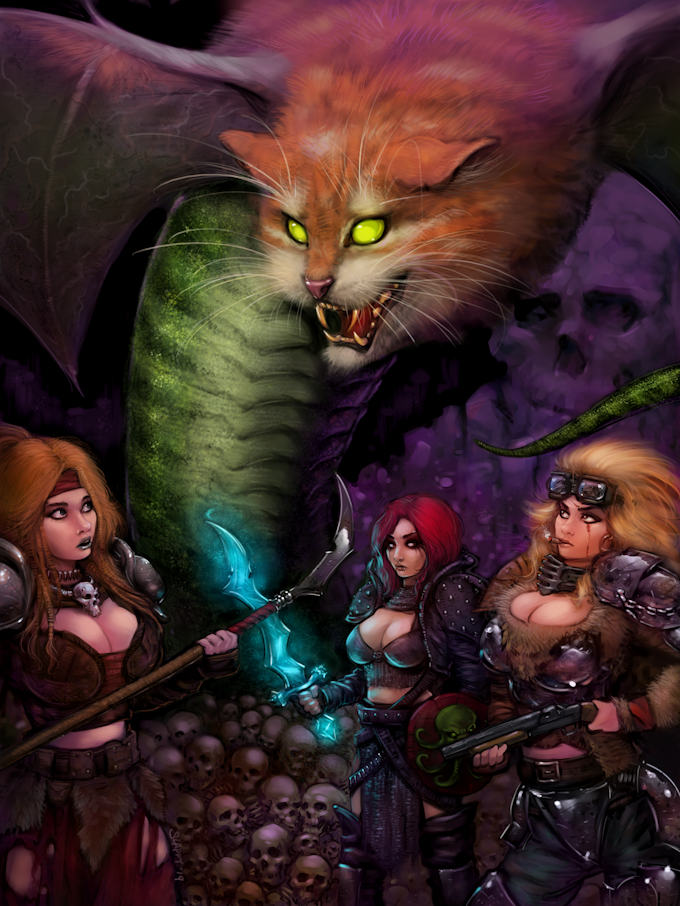
Showing posts with label adventure. Show all posts

Monday, 31 October 2022

[Review] Castle Drachenfels

I'm pretty sure I've seen this
illustration before...
Let's celebrate spooky season with a horror adventure! To make things interesting, it is not one written for Call of Cthulhu, World of Darkness, Lamentations of the Flame Princess, or any other horror game: Castle Drachenfels is a Warhammer Fantasy Roleplay 1e adventure that takes you to the creepiest place the Old World has to offer.

WFRP is one of my all time favourite tabletop rpgs thanks its career,system, visceral combat, volatile magic, and badass setting. Alas the latter suffers from a serious identity crisis. Is it an unholy lovechild of Tolkienian and Moorcockian clichés? Heavy metal dark fantasy with gritty heroes and unspeakable horrors? Grimdark low fantasy of crapmongers dying from syphilis and critical hits? Epic high fantasy with dragon riding heroes and fancy armies? It depends on which iteration you are looking at.

Jack Yeovil's1 1989 novel Drachenfels takes the murder mystery / gothic horror approach. The novel starts where most stories typically end. A group of adventurers led by the knight Oswald von Konigswald and the vampire Genevieve Dieudonné infiltrate Castle Drachenfels. Most of them ends up killed or incapacitated, but in the end Oswald fights and defeats the castle's lord: Constant Drachenfels, the vilest sorcerer of the Old World. Twentyfive years later Oswald hires the playwright Detlef Sierck to recreate the Great Enchanter's defeat on stage for the event's anniversary. The play will debut in Castle Drachenfels, and the audience will include Karl Franz and the few survivors of the original party, among others...

Drachenfels is one of the better classic Warhammer novels2, and its titular antagonist is my favourite Old World villain. He is a master necromancer and daemonologist. He is as old as mankind. He is phyisically imposing and wears a cool metal mask. He has no tragic backstory and not an ounce of humanity left. He commits crimes against humanity just for shits and giggles. He is like Doctor Doom, but without any redeeming qualities. Nagash, Malekith, Archaon can kiss his ass, they are lame.

Castle Drachenfels is a unique piece among WFRP1e modules. It has neither dark conspiracies to unveil, nor epic journey around the Old World: it is a dungeon crawl focusing on a single location, a huge ass haunted house. While there are some ideas how to insert the module into The Enemy Within, The Restless Dead, and The Doomstones campaigns, I advise against doing so. Use it as a stand alone adventure instead, with lots of backup characters, because it is a fucking deathtrap even for experienced characters. 

Players won't see much of the Great Enchanter during the adventure: he is either dead or in the process of regenerating. For the latter scenario there is a ticking clock mechanism based on the number of rooms the characters explored. The longer it takes to reach him, the closer he is to recovering his ultimate form. Don't fret though, his fortess is a worthy adversary and a character on itself. It is like a living organism invaded by a virus - it will mess with the intruders and retaliate when attacked. It is also indestructible until the weather vane is removed, which will release a hellish storm and a Fiend3.

The place is chock full of memorable encounters. Some are scary, like the corridor of gargoyles, others are silly, like the insulting puppet theater, and then there are some really fucked up things that belong in a LotFP adventure, like the kitchen where the zombie servants turn into familiar people, start flaying themselves, and throw their flesh on the grill. While some sections of the dungeon have a central theme, most rooms feel like set pieces thrown next to each other without rhyme or reason. The casual use of fantastic scenery might also surprise WFRP fans - rooms leading to the Realms of Chaos, spectacular permanent magical effects, encounters with powerful creatures are not uncommon. The warp points and passageways are also worth mentioning: while these paths that bend time and space are far from the central feature of the castle, there are several of them and they can mess up mapping and exploration greatly. While there is an appendix with ideas to spice them up, even there the general advice is to not overuse them, because they are frustrating.
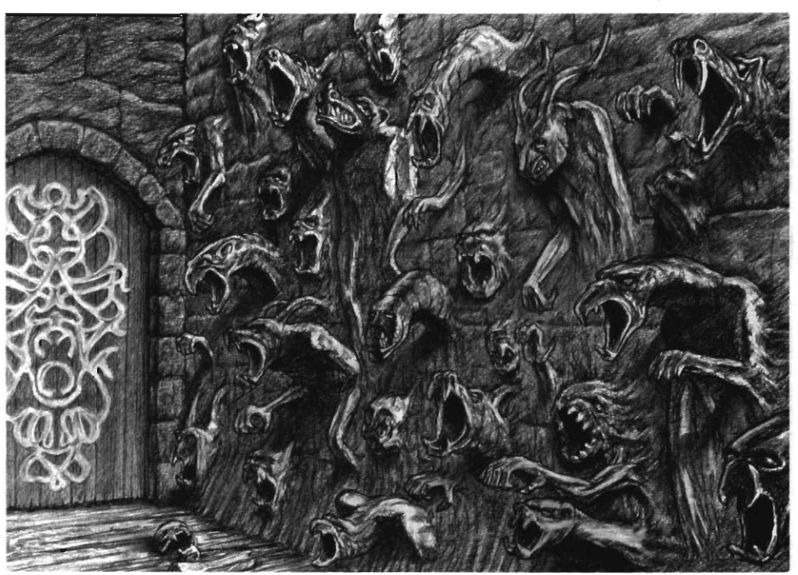
The famous "nope" corridor of Castle Drachenfels.

There are two gauntlets that are grossly unfair. What do you say about a trip to the fucking Realms of Chaos? How about four in a row with no turning back? The other challenge has four alignment themed rooms, with the final leading to the coffin of a powerful vampire lord and his sidebitch. The latter will feign friendship to keep you occupied so her master can wake up from his beauty sleep - then you are fucked. This scene actually rewards murderhoboing. There is a yawning dude in the coffin? Stake the bastard! Shit like this makes it hard to trust the few actually helpful or not immediately murderous NPCs.

Speaking of NPCs... This is one of the weaknesses of the adventure, and not because those present are badly written or uninteresting, but because most of them are hostile, distrusting, and loyal to Drachenfels. Interactions with them promise to be fun, but rarely rewarding. Even the few genuinely helpful ones won't be of much use. Gerd the Mutant is grateful if you wake him up from his magical sleep, but a few turns later he dies from a chestburster that was kept in stasis by his slumber. Snitlet the Snotling is more of a comedic relief than a useful companion, but at least he is an entertaining one4. Bardul the Hunchback is the only with potential long term benefits for the party, for he knows the castle well and can navigate the warp passageways. There are also spirits, but they are more like dumb tools for the GM to foreshadow, or railroad the players, or mess with them. The appendix offers further NPCs to add colour to the place, and you should absolutely use them. My favourite is a band of greenskins called Gobrot's boyz, whose leader is smart enough to ally with the PCs if they prove themselves useful, and whose "gurly" will start flirting with one of the PCs just to stir up trouble.
Rewards are plenty. Slaying the two bosses can earn the characters 3 Fate Points, though they are likely to lose just as much in the process. The XP awards look good, and there is a great deal of magic items - including some cursed ones. There are dozens of potions, the Wand of Dust, which is the bane of undead, Blackshards, which are focused negative emotions that can be exploded in someone's face, Lermontov's Grimoire, which contains the extremely useful Cure Insanity spell, or Warptorches, which help navigating the warp passages.

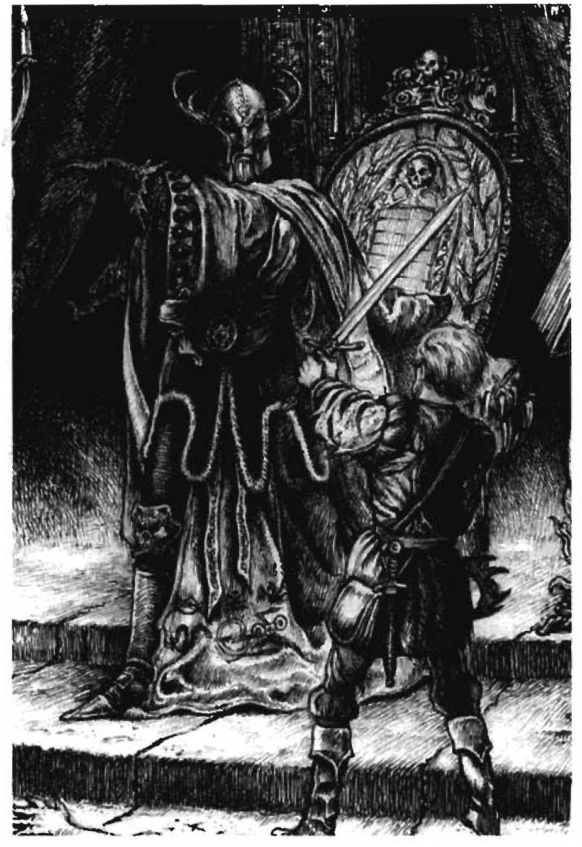
Drachenfels himself towering over
some unfortunate soul.
Why would anyone visit this hellhole though? The book offers a few ideas, for some reason in the back of the book. The seeds include cultist hunting, sabotaging the stronghold, recovering someone's heart literally, or stopping the resurrection of Count Drachenfels. They are more than hooks: you get a half page outlines with a beginning, complications, and an ending. Several of them introduce further NPCs, which as I mentioned above, the adventure needs badly.

You know what else it needs even more? Good maps. Castle Drachenfels pisses me off in this regard. The overview maps only show walls, stairs, and doors. Windows? Nah. Furniture? Forget about it. There are floorplans for a few rooms, which are more detailed, but alas that's just a small fragment of them. Even worse, there is no grid. There is a scale on each map, but it is much easier to estimat distance by counting squares than pulling out the tape measure. The dungeon layout is non-linear, but would benefit greatly from some secret doors. The writing is good old-fashioned Games Workshop stuff: it is evocative and fun to read, but a bit too wordy for its own good. Adding more highlighting, bullet points, and cross referencing would also improve the usability of the text, but we are talking about an adventure from 1992. The art is top notch like in every other WFRP product of the era, though there are reused assets familiar from other books.

Due to its vulnerable player characters and being a product of the late eighties and early nineties, the typical WFRP adventure focuses more on intrigue, investigation, and characters. Despite bearing the marks of its era, Castle Drachenfels is an odd exception, being an unforgiving gonzo funhouse dungeon. It is WFRP's Tegel Manor and Tomb of Horrors in one, and despite its shortcomings, I can't help but appreciate it for that.


Rules system: WFRP1e
Publisher: Games Workshop
Publication date: 1992

Format: print, pdf
Size: letter-size
Pages: 112

Available from:
  DriveThruRPG (pdf)
86%
Old-fashioned meatgrinder,
Warhammer style!


1 Also known as Kim Newman.

2 Canonically the novel is outdated with its oddities like Karl Franz being crowned emperor in 2491, goblins working for humans, vampires mingling with men openly and living in asylums, et cetera. The Empire Drachenfels depicts is a more open-minded and chaotic country than what you can see in the modern lore. 

3 "...a spirit of pure Evil, drawn from the Warp where all things are possible and everything exists, by Drachenfels himself." Cool shit.

4 Snotlings are always entertaining.

Disclaimer: The DriveThruRPG links on this site are affiliate links. If you buy something through the link we'll get some credit for your purchase too.

Wednesday, 13 July 2022

[Review] DIE! DIE DIE! PIG ORC!

Oink oink, motherfucker!
Eldrad Wolfsbane of Meat Grinder fame is back and does exactly what you expect from him: unleashing his inner twelve year old to create cool modules for old-school D&D with shitty art1, monospace fonts, and lots of exclamation marks! If the title of DIE! DIE DIE! PIG ORC! was not enough to get you in the mood of slaughtering humanoids, then absorb the introduction too:

The kingdoms of the Northwestern Lands have fallen and the wars have been lost! MAN, ELF, DWARF and HALFLING are on the run or are waiting for THEIR DOOM!
Gnolls from the northeast!
Piece of SHIT Gnolls!
Fuck Gnolls!
Goblin's, Hobgoblins and Bugbears from the East!
Killing! Snorting! Raping!
Goblinoid FUCKS! We hate them!
Fleasheaters! They kill and eat the women and children!
They even eat the babies!
The ROTTEN Undead from the Southeast!
That ROTTEN Undead! That SMELL!
In the Kingdoms of the East, Mankind is being wiped out!

Do you feel the raw energy, the unbridled passion, the sense of imminent doom immediately? It makes the blood boiling! Yes, fuck those humanoids indeed! And this goes on as the author introduces the land from the point of view of desparate refugees who cannot find peace until finally reaching HIGHHILL town. The port town has a handdrawn map, some rumours, a paragraph for each quarter, and of course random encounter tables! Day encounters are your run of the mill port town encounters, with the sole exception of some rakshasas2 serving as a middle finger to player characters. Night encounters have a better chance of ending up nasty, with the table including a wight, a vampire, or the specter of Old Mr. Gunderson the old dead Werewolf Hunter. That's what I call local colour!

Well hello Mr. Fancy Pants!
Highhill is followed by The High Forest Wildecrawl. We get eleven local encounters, including pompous mercenary douchebags waiting to take advantage of the local conflict, a haunting nightmare, a pack of hell hounds, a huge ass necropolis, and a sprawling swamp ruled by morlocks, among others. I love the NPC names. DEATH MONGER, Groggy Monley, Big Stinky Betty, Chopper the Ogre - even without description they immediately evoke an image about their owners. Beside names most encounters have some detail that make them memorable. One that really stood out  to me is the Lone Troglodyte:

A Lone Troglodyte lurks here. He wears ornate Plate Male and Shield and carries a grand sword. He has a backpack full of supplies. He appears to be looking at a map and is strangely far more intelligent than an average Troglodyte. He plans to find the treasure on the map and quietly retire. He had an entire party of fellow Troglodytes but they had all slowly been killed off and he is the LAST ONE!

That's a surprising amount of background for a surprisingly unorthodox NPC. He has the potential to be remembered and talked about years later by your players. Cool wilderness encounters earns +10% for the final score. There are no hexes on the handdrawn wilderness maps though, which earns -10%.

The final section is about the Old Holy Fort, a 21 room dungeon invaded by those goddamn pig orcs! The map is disappointingly linear. It has some branches, but there are no loops, there are barely any secret doors. It needs some heavy Jacquaysing, right now! The party will face all the orcs right in the very first room, and if they are laser focused on killing them they will quickly finish their mission - or die trying. There is more to the dungeon though than orc barracks and shitting rooms! Beyond their quarters lie a path to the underworld, rooms of critters, crypts with lurking undead, and a mysterious underground area hidden behind an altar where morlock priests breed humans as livestock. The latter was unexpected and got close to Lamentations of the Flame Princess territory, but the author stopped at barrels of pickled humans and generational slaves.

21. Past the secret door is actually where the Key of Deadmoore is held. In an untrapped display case. A mysterious laughter erupts for a few seconds when a PC gets the key. END

Awesome! That's how you end an adventure! Don't tell me you wouldn't be hyped after such ending to see what's coming next!

DIE! DIE DIE! PIG ORC! is deliberately amateurish, juvenile, minimalistic, but does not feel artifical like 50 ShaDes Of vOrpal3 and is actually playable. Behind the rampant ramblings of a youngster lies an adventure with terse, evocative, and fun encounters. It ain't no Meat Grinder, but hey, you cannot churn out a cult classic everytime!

Rules system: B/X
Publisher: Eldrad Wolfsbane
Publication date: 2022

Format: pdf
Size: letter-size
Pages: 24

Available from:
  DriveThruRPG (pdf)
75%
It definitely has pig orcs
who should die - and more!

1 Except for the occasional public domain images of course.

2 I had flashbacks of City State of the Invincible Overlord, where your daily stroll to the grocery store can easily become a deadly encounter with a high level monster.

3 50 ShaDes Of vOrpal does deserve a praise for its art, because that feels totally authentic. When I was twelve those who were "good at drawing" drew exactly in the same style as seen there.

Disclaimer: The DriveThruRPG links on this site are affiliate links. If you buy something through the link we'll get some credit for your purchase too.

Sunday, 28 February 2021

[Review] The Palace of Unquiet Repose (DCC RPG)

A Domain of Decay.
A few years ago Prince of Nothing and Malrex released The Red Prophet Rises, an OSR adventure that did a stellar job at capturing the essence of sword & sorcery with its ultraviolent barbarian cult, dreary canyons, and antediluvian ruins. I can't recall when the Prince of the Lowlands started teasing his next project, The Palace of Unquiet Repose, but I was hyped from that very moment, and it seemed like an eternity until the Kickstarter campaign launched. The campaign was successful enough to spawn three conversions of the module: one for Labyrinth Lord, one for Old-School Essentials, and one for DCC RPG. Poor For Gold & Glory got the short end of the stick this time - it's a shamefully underrated retroclone that deserves more attention. But I digress... I have all three versions at my disposal1, but for this review I went with with the best game the OSR has ever seen: DCC RPG.

The DCC RPG version of The Palace of Unquiet Repose is a 75 pages long book accompanied by a 14 page bonus adventure called The Screaming Caverns. The almost monochrome still-life of the cover stands in stark contrast with the violent ritual seen on The Red Prophet Rises, and the eerie black and white interior further reinforces that the days of high adventure and barbaric splendour are over - welcome to the Age of Dusk, a bleak era still suffering from past calamities!

While art is great at giving first impressions and setting the tone, it's purpose is to supplement the writing2. Prince nails it effortlessly. He focuses on the important set pieces of each scene, highlighting their defining features in a terse but pompous prose. Ominous features are left for the last, making them linger on. That's smart pacing, that's how you do effective foreshadowing. Once you absorbed the feel each of the bolded keywords gets its spotlight in a bullet point list. The art and the writing together create a powerful atmosphere unlike any other. The Palace feels like an oppressing, melancholic, and haunting relic of bygone, alien times. It is grandiose dark fantasy reminding me of the depressing world of Berserk, the melancholic journey of Dark Souls, the disturbing art of Giger, the droning songs of Celtic Frost3.

"The Glass Wastes were once the site of an empire, so horrible none dare remember it."

The Palace of Unquiet Repose doesn't waste much time with introduction and summary: it starts throwing useful stuff at you right away, including some damn good hooks (like horrific visions of antropophagy driving a character to the wasteland), juicy rumours (some of them are needless to say utter bullshit), and some random NPCs (most of them aren't right in the head). Besides being useful in kickstarting the adventure these also give a good picture about the status quo. Deep in the desert an earthquake revealed a ruin built by the race of Tzyan - an ancient people who not only hated the gods, but built weapons to kill them. A squad of Sial-Atun mercenaries deserters, a cult of Tzyan called the Nine, and various ne'er-do-wells are looking for the place.

The Palace is a week's travel on foot from the city, during which Dusk Stalkers will harrass the party. They are the cooler cousins of the owlbear - they have a paralyzing scream, they use smart tactics to stalk their prey, they wrap themselves in the skin of their victims, and are actually the descendants of degenerate humans. Their behaviour is smart and believable, and will force the players to think through how they camp if they want to both rest and survive.

"Eroded by the ages, the malevolent visage of some ancient prince gazes down imperiously from a monstrous body of ancient stone."

Once the party reaches the basin they can enter the mythic underworld either through a basalt sphinx [sic] or a fissure. The sphinx leads to a collection of chambers full of ancient traps, eerie murals hinting about the place's forgotten history, and some unusual treasure in form of gilded skeletons. The fissure is shorter, safer, but much more foreboding. Infiltrators are greeted by a camp of mutilated corpses and a Dusk Stalker impaled on a spear among a row of statues, whose mate will attack the moment someone starts tampering with a nearby treasure. 

"Rising from a lake of shimmering quicksilver and misty vapors, back-lit by eerie witch-light, the Palace of Unquiet Repose stands monstrous vigil over a city of the dead."

The two entrances offer different kinds of horrors, but ultimately both lead to the Black Shore. A lake of mercury with a colossal statue of the sorcerer Uyu-Yadmogh emerging from it, wall full of miniature carvings depicting torture and perversion, an evil shrine where one can be baptized to protect himself from the upcoming horrors at a cost, a forest of petrified trees stalked by a glass concubine, the dispirited rearguard of the Sial-Atun mercenaries... The disheartening landscape already offers memorable encounters, and it's still just a prelude to the Palace, which awaits patiently in the background, behind the lake of mercury.

"Nothing can be heard in the city but silence."

Even the walls have mouths.
The haunted ruins of the Necropolis is where the shit hits the fan. The Sial-Atun mercenaries have a base here. They were lead here by Captain Sarakar looking for untold riches, but are stuck here and tired of this place. Among the terracotta and obsidian plants of the Gardens stands the Crystal Tree, which prevents any kind of violence within its sight. It's worshipped by the Children of the Tree, a bunch of hippies living on the fungi growing on the tree. Their leader is the Father, who went crazy and can change from Mother Teresa to Hitler without warning4. He also has an Infinite Dart, a branch of the esoteric tree, the only weapon that can be used in its presence and can damage even the gods. Finally, among the ruins lurk the Nine. They are cultists of Tzyan with unique special abilities and pretentious names - they are not unlike JoJo villains. The Thousand Faced Prince can shapeshift without magic, The Walker in Dreams can leave his body and enter people's dreams, The Shaper of Things to Come can shape clay and stone into weapons, et cetera... Their leader is the hauntingly beautiful Khabareth Who Comes Before, who bound a Wolf of the Final Night into her bidding, a nightmarish shadow creature from the End of Time even she can't fully control.

If the potential faction play wasn't enough, the Necropolis still has some tricks in its sleeves. Nomen est omen, the place is full of corpses, and is haunted by the Azarog, a nigh invincible and invisible creature that is limited in movement but can reanimate the dead to its heart's desire. The scenery also has some memorable objects to play with, but my favorite is probably the Vae Victis, where the still-alive severed head of a lesser god is held on display. When the gigantic face is questioned he keeps repeating creepy prophecies. When the shard from his forehead is removed he answers a question truthfully before perishing. The shard is a deiphage, a dagger that can wound the gods, but can also grow into the wielder's hand and slowly turn him into one of the undead.

"A baroque monstrosity hewn from basalt, obsidian and crimson marble, every square inch covered in reliefs and figurines, super-imposed over one-another as if capturing all possible facets of their nature."

There are several ways to enter the Palace. There is a hallway covered by gaping mouths, that drain your soul unless you have one of the pebbles from the Black Shore, or you threw enough people at it to deplete the trap. If the players manage to bypass the traps the Sial-Atun and the Nine will follow. There is a secret entrance in the Necropolis through an optical illusion revealed by meditating. And finally one can enter through the roof, but it's a difficult climb made harder by the tiles turning into gargoylesque guardians.

How blood sausage is made.
The Palace is baroque, grotesque, and rich beyond imagination: walls are made of gold, treasure stands in piles - literally. There are even rules for vandalizing the place for treasure, which I found amusing. While it might be tempting, it's not necessarily a wise idea. Like the Necropolis, the Palace has its watchdog too. Diorag the Breaker is the re-animated corpse of a demigod chained to the throneroom with 1000 feets of adamantium. Once he learns there are intruders he will follow them and even pop up as random encounter. If the characters can avoid or trick him, they can still be eaten by salivating walls, seduced by glass concubines, impaled in the heart by an immovable nail, splashed with cursed gore by the half-idiotic Master of Cerenomies, or betrayed by a chaotic artifact.

Intrepid players can also descend to the second level, where Uyu-Yadmogh, the Tzyanese prince who built this Palace can be found. He is more of an abominable object than a monster, a colossal fusion of the sorcerer and his minions. He is surprisingly firendly, willing to show his visitors what Judgement awaits them, and offers the secret of avoiding it for the head of the Sial-Atun and the Nine. If his offer is refused or someone tries to take The Tome of Iron and Glass from him he will go mad and start animating corpses and draining souls until he is destroyed - though only two objects can kill him permanently...

The module ends with almost as many appendices as the AD&D1e DMG. I will highlight four because they cover topics I want to dwell a bit more on.

Appendix A sums up the factions, a defining element of the Necropolis area. All three of them has character, iconic NPCs, and a goal which they actively seek to achieve. They are equally willing to ally themselves with the players or murder them to get what they want. Even the hippies when the Father gets in paranoid mood on his random table. Fuck, he is willing to destroy his own, who are willing to sacrifice themselves for him... Though they have less important roles in earlier and later parts of the adventure, the factions make the Palace and its environs come alive and provide memorable friends and foes.

Appendix B lists a bunch of magnificent magic items. One of my favourites is the Cask of Unknowing, which makes people forget about the bearer, but too much use will reduce the bearer's personality and turn him into a non-being. The Many-Angled Instrument of Ethereal Imprisonment is basically the trap from Ghostbusters. The Tome of Iron and Glass contains Nth level spells which require an hour of chanting and a DC 20 spellcasting check to mess up an entire area - except for the imperfect Transcending the Fetters of Mortality, which destroys the ritualist and blinds those around him. The book also contains two adventure hooks (or sneaky advertisement), foreshadowing what modules to expect from the Merciless Merchants in the future. While not as exciting as the magic items, even the mundane treasure is kept interesting, often by the sheer amount of it and the challenge its recovery poses.

I loved you in Dark Souls!
Appendix C collects some of the new monsters. Horrifying beasts are just as important for creating a dark fantasy atmosphere as the eldritch environment. An evocative description is only half the battle though, the creatures must have abilities that put the fear in the metagamer's heart too. The Palace of Unquiet Repose satisfied me both visually and mechanically. Some encounters feel like something right out of Dark Souls. I'm particularly fond of the invincible boss monsters that requires cunning or the serious waste of resources to get through - straight up fighting them usually means quick death. Then there is shit that's just plain weird, like the glass concubines. The idea of autonomous realdolls isn't that weird by default, but making them from glass and electrum, and making one with the lower body of a dragon? I wouldn't touch Prince's browsing history with a ten foot pole...

Appendix F is a topic near and dear to all DCC RPG fans: patrons! The Palace of Unquiet Repose introduces two of them with unique Invoke Patron results, patron taints, spellburns, and spells. The Tesseract Tree worshipped by the Necropolis hoboes is older than the gods. It can not only cease violence, but awaken animals to sentience, hand out Infinite Darts, and even alter reality. To form a pact one has to crucify himself on its branches. The Tree is only willing to have one pact at a time, so before nailing yourself to a tree you have to kill the Father. Uyu-Yadmogh on the other hand is not so picky, though his spells aren't as exciting either: they can sow discord, age creatures, and petrify. Invoke Patron can summon Azarog though, which is nice.

The Screaming Caverns is the cherry on the cake. This exclusive adventure is about slaying a Sial-Atramentar, a maimed servant of the fallen gods that can be only harmed in one specific way. The players will have to figure out that condition through rumours, oracles, or random luck. There is an unpleasant twist though once they enter the monster's lair: he has a friend too. One of them can resurrect the dead but with malfunctions and a hatred against all things they loved in life, the other can shape stone and entomb living creatures in it. The Screaming Caverns is a fun monster hunt that requires a lot of preparations and is very easy to fuck up because of false rumours or lack of information.

I left the layout for the last. While mostly it's clean and uses highlighting, bullet points, cross referencing effectively, it's far from perfect. The way NPCs are presented is confusing. There is an italic description first, followed by stat blocks, equipment, and details. The problem is there is no heading or title telling you that a new section begins, and whom it's about. Even a cheap trick, like putting the stat block first would have helped in differentiating the sections. My other issue is with charts. They are chunky and often flow into other pages. This is a frequent problem for charts with large chunks of texts, like random encounter tables containing stat blocks. They are also ineffective: the cells are full of unused whitespace, making me cringe. I recommend formatting tables so they fit in a single page, and rethinking how columns and rows are used to minimize wasted space.

The Palace of Unquiet Repose exceeded my expectations. It walks on the razor's edge, finely balancing between Negadungeons and Monty Haul. It's a horrible place that can destroy your precious characters, but it isn't unfair and offers unimaginable rewards for the risks you take. It is dark fantasy done right - there is no self-irony, no random bullshit for the sake of weirdness, just foreboding atmosphere delivered with unparalleled craftsmanship. Well done!


Rules system: DCC RPG, Labyrinth Lord,
    Old-School Essentials
Publisher: The Merciless Merchants
Publication date: 2021

Format: softcover
Size: letter-size
Pages: 75 + 14

Available from:
 DriveThruRPG (pdf, print on demand)
92%
An atmospheric
dark fantasy masterpiece.

1 I originally backed the DCC RPG version only and gave some feedback after reading the beta version. Not sure if it's because that or to honour some silly old agreement in the Age of Dusk blog's comment section, but my pledge level was upgraded to have all three versions.

2 I wanted to write a review about Xanadu last autumn, but scrapped it because my judgement was clouded by how I didn't get what I expected based on the pixelated old-school crpg art.

3 The book even starts with some Celtic Frost lyrics on the second page. Another band it reminds me of is Melechesh because of the Middle Eastern influences and occult topics.

4 He also has a 10% chance to die during a seizure. Good times!


Disclaimer: The DriveThruRPG links on this site are affiliate links. If you buy something through the link we'll get some credit for your purchase too.

Monday, 26 October 2020

[Review] Cha'alt: Fuchsia Malaise

Mandy meets Venger.
Sponsored content.

I thought I was done with Cha'alt after the exhausting three-part review I wrote earlier this year. I thought I can finally leave its mad vistas behind, come clean, return to normalcy, and recuperate. Then I heard a siren call from beyond the depths of the Void. The message was in za'akier, yet I understood it loud and clear. I knew immediately who was summoning me. "Hey kid, wanna buy some zoth? You know what, forget it. Here is some fuchsia malaise. It's new. It's free. You're welcome." It found me in a moment of weakness. I couldn't reject the offer. And here I am now, writing again about Cha'alt, when not staring at the fuchsia skies with a drop of drool hanging from the corner of my mouth...

Cha'alt: Fuchsia Malaise is a supplement for Cha'alt, the magnum opus of the Venger Satanis - madman, troll, za'akier, priest of Cthulhu, loving father, and old-school D&D enthusiast. Like its predecessor, CFM was also crowdfunded by a Kickstarter campaign - one that I missed. Fortunately when I was about to put the pdf in my DriveThruRPG cart the author asked me if I'm interested in a complimentary copy. Kudos for that hoss, and sorry for sitting so long on the review. It seems fate always tries its best to hinder me when I'm writing about Cha'alt.

If you are unfamiliar with the first book and too lazy to read my review (which I can completely understand), Cha'alt is a post-apocalyptic science-fantasy gonzo setting probably written on drugs, with one tentacle in pants. Besides being absolutely bonkers it also has a huge ass mega-dungeon called The Black Pyramid, which defies all logic and dungeon writing advice. What CFM offers is basically more of the same, but with a bigger emphasis on the world and its happenings.

The first chapter, Essentials, start swith summarizing the current status quo. CFM picks up 18 months after the events described in Cha'alt. There is a new sheriff in town, the alien company called Elysium, who are now in control of the entire zoth1 industry. They banned spice fracking in favour of slave labour, and use a drug called Fuchsia Malaise to keep their workers in a lethargic state until the next shift begins. They are also siphoning the planet's moisture, which turned it drier and even more hostile than before. The Chartreuse Sea dried up, the freed Kra'adumek's future is still uncertain, violet and purple priests wage an open war, while the evergrowing city of A'agrybah became the center of civilization. That's a great point to start a campaign, but the prelude barely scratches the surface. There is a lot more going on that's not covered here, but the information is all over the place, so it's up to you to pull all the bits and pieces together as you are plowing through the book.

These new times brought new races to Cha'alt. Blue velvet elves are amazing at everything and suave as fuck, but if something bad happens to a party-member they suffer the same effects, and they are also hunted for their pelts. Grogs are soulless sand-constructs capable of disassembling and reconstructing their bodies. Vores are reptilian bird-men without mouths, who can communicate telepathically and can digest anyone by wrapping their wings around them. V'symm are seven-eyed infernal creatures hiding their faces behind bronze masks, which are quite uncomfortable for long desert trips. I have a soft spot for the weirdo new races - they flavourful and unique. Are they balanced? Nope. Does it matter? Nope. This is still Cha'alt, the world of overpowered monstrosities and random deaths.

The rest of the chapter is mostly Cha'alt specific charts and miscellanea covering a surprisingly wide range of topics. The party got some important item? Here is a chart for who is following them and why. The party asks some random schmuck on the street? Here is a chart for traits, usefulness, beliefs. The party summoned some demon? Here is a chart for demonic offerings and favours. The party has a sorcerer? Here is a chart that will make their life hell. What I really appreciate about these tables is that most of them are meant to be used on the fly. They also do a damn fine job about capturing the setting's essence with weirdness, pop culture references, psychedellic sights, and of course some vengerian sleaze. Just take a look at this lovely random example from The Fuchsia Shadow (spell mishap) table:

I don't recall seeing stats for the
protoss, but it looks like they are
here too.
"Head Falls Off – The sorcerer’s head falls off immediately after the spell is cast – up from the neck hole sprouts all manner of tentacles dripping a jaundiced yellow and purple slime. Soon after, the tentacles devour the sorcerer’s corpse and give birth to an egg. Then, the egg hatches. A miniature-sized version of the sorcerer climbs out as he slowly enlarges to normal size. The whole metamorphosis takes about an hour."

You don't see shit like this in the dull D&D5e wild magic tables. It might be ridiculously over the top or juvenile sometimes, but it's also damn cool. Using the charts on the fly is hindered though by the the lack of organization. There is no rhyme or reason why things are in the order they are, unless they follow some extraterrestrial alphabetical order. If you want to use the book get familiar with the index, because this won't get any better in the following parts either.

The second chapter is about The City of A'agrybah. Like your adventures in the city, the section begins at the gates, where exiles hang around telling juicy rumours about what's going on behind the walls. The book then moves on to explaining how taxes work (and can be evaded), who are the ra'as and how can one become one of them (it involves 10,000 gold pieces and a pact with a devil), which are the noteworthy noble houses, and what is the water ritual.

A'agrybah has a few points of interest, including a colourful marketplace, the King's and Queen's palace, a temple where they resurrect people for 1,000 gp, a barely used spaceport, and various taverns. These get terse descriptions, which are a mixed bag. Check out The Chartreuse Dragon:

"The interior of this tavern is lit with zoth lanterns, giving the place an eerie yellow-green glow. An assortment of instruments hang upon the wall, all of them painted fuchsia. Various dirty and disheveled humanoids sit, drinking and eating."

Short and evocative, it sets the tone in three sentences and tells you enough to know what kind of place this facility is. Well done! Now compare it to The Burnished Soul:

"Another tavern filled with disreputable scoundrels."

That's generic and useless. It baffles me why is a damn good example of effective writing followed by something so bland and uninspired. If it was longer at least I could say it's a filler - I despise them, but at least they have a purpose. This has no reason to exist, but at least it manages to piss me off, because it would have taken zero effort from someone with such madcap imagination to barf up something that makes the place at least mildly interesting. There are a few more similar swings in writing quality throughout the book, but I wouldn't say it's plagued with them.

At least the hooks are good. Each place gets three to five of them, ranging from random encounters to adventure seeds. A merchant selling a three-eyed emerald snake, a bounty hunter looking for the bastard who sold him a junk starship, an apprentice begging for money so he can resurrect his master who was killed right after he discovered the meaning of life, universe, and everything... If these weren't enough, there is also a short table four tour guides who will gladly show you around the city, and a lengthy table for random unlikely events.

I'm torn about this chapter. On one hand A'agrybah itself is characterful and has a lot going on. On the other hand only a very small number of places are detailed, and some of those are done in a lackluster way. There is potential, but the execution needs improvement. Also, a map would be welcome. I don't expect anyone to go full City State of the Invincible Overlord, I don't even need the exact positions of buildings and precise ranges - just a vague sketch about what's where.

No clue who he is, but I have a hunch
he came here for the prostitutes.
The third chapter is Encounters, containing is a mishmash of places, scenes, monsters, charts, and important NPCs in no particular order. Two of them will get some more mention later. The Fuchsia Putrescence is a mile long floating entity randomly grabbing up people from the ground. Because its fallen slimy bits have healing properties, people began to worship the thing. Tha'anos is a scrotum-chinned warlord looking for the Rainbow Gemstones of Ultimate Power, which are hidden on Cha'aalt. Once he has all of them in his codpiece, he will create a cube outside time and space, where he can finally finish painting his miniatures while time stand stills. He is totally relatable villain, at least for me.

While it won't have any significant role later, I would also like to mention my favorite creature from the book: the clown-worm. It is a mix of sand-worms and demon-worms bread by the murderous night clown of The Black Pyramid. It's far from the most powerful entity on Cha'alt, but it can turn people with its sight into its clown thralls, and has all kinds of crap in its belly, including a magical weapon with a bonus against gods. The worm's full-page illustration is a thing to behold.

Onward to chapter four: Scenarios!

Fuchsia Flesh-pit is a genetic experiment of the wizard Vromka'ad, who was recently killed by his jealous bride La'ala. The girl came to this flesh pit looking for the other half of the glove she stole from the wizard, but she had to realize that it's dangerous to go alone: there are tentacles, mutant clams, evil cultists, a whispering cronenbergian monstrosity, and other weird shit within the organic hellpit. She tries to persuade the party into coming down and helping her out, after which she would try to betray them and leave with the treasure. It's a simply laid out, short dungeon, where the players are just as likely to release an Old One upon the world as finding a secret entrance to a synthwave lounge bar. Overall it's a decent module for a one-shot.

Tower of Vromka'ad takes place in the above mentioned wizard's tower. Since Vromka'ad's death the servants have taken over, and are now busy bickering among themselves. There are twelve colour coded rooms which could be reached by touching the corresponding orb in the entrance. Each has an interesting set-piece, but otherwise they rarely have anything else to offer. The servants are few, mostly very weak, and not worth bothering with. There isn't much loot except for the room with the three warriors and some magic items (those are pretty nice though). It ties neatly into Fuchsia Flesh-pit by wrapping up some of its mysteries, but overall Tower of Vromka'ad didn't leave much of an impression.

Tomb of Va'an Zayne is a more traditional dungeon than the previous two, with a proper layout and twenty rooms. Va'an Zayne was a sorcerer and writer, whose tomb is so frequently mentioned among the earlier rumours that it's nigh impossible the party won't hear about it. The sepulcher offers a good deal of interactivity combined with a selection of intriguing NPCs. There is a writers circle right at the entrance, a trapped clone of Elysium's head honcho, asshole energy beings taunting cultists, a play-doh statue that can summon demon, a post-modernists and anti-modernists arguing about bullshit, a gate to The Islands of Purple-Hanted Putrescene, and so on. Every room has something noteworthy and fun going on. If this wasn't enough, the tomb is tied to Cha'alt's greater metaplot in several ways. The place was raided not so long ago by Tha'anos, there is a Key to Time in Va'an Zayne's tomb that can erase time, and there are revelations about the true nature of the Old Ones and the planet's future. These open a can of worms and foreshadow a bleak future, which I hope Venger will explore in Cha'alt: Chartreuse Shadows.

A hive of scum and villainy.
Elysium
 is the biggest of the bunch, and probably my favorite. The module starts with introducing the alien races, factions, personnel, security systems within the facility, then without further ado moves unto describing its 56 rooms. Elysium feels like a living, fully functional complex. It is the most grounded from all the Cha'alt stuff so far, yet it still remains gonzo enough to not become just another boring futuristic base. The fantasy and weird fiction elements here are diminished in favour of science-fiction parody. The humour and the art feels like a distant cousin of The Hitchhiker's Guide to the Galaxy that replaced the british smartness with animated american sitcom vibe. Besides zany characters chasing their own (often shady) agendas there is all kinds of dangerous science to play with - the characters can try to stop a black hole generator, fiddle with THE INTERNET, destroy Elysium's reactor, et cetera. Furthermore, like the Tomb of Va'an Zayne, Elysium also has some mindfuckworthy lore drops and stuff related to the various ongoing events. It is by no means as large and exciting as the the Black Pyramid, but it's still a damn fine module and the zenith of this book.

S'kbah Pilgrimage is kind of a character funnel, thus it should have been the first in order, but I don't mind it being at the end of the book. The party is thrown out from the village to stop a plague of blood-sucking locusts, and aren't even allowed back until they succeed. I don't even know if returning is covered at all though, because I kept zoning out while reading it... The entire adventure is a chaotic railroad where the GM yanks the PCs from one cool scene to another. They are mostly well-written and do a fine job at establishing what's the setting is about, but the pilgrimage tries to do too much too fast - from desert travel, through subtrerranean Ka'ali worshippers, to fixing the generator of scheming dark elves... It's hard to follow its jumps between all the goodies it wants to show you and ends up being a confusing mess.

CFM ends with an appendix that contains three free products from earlier: the Crimson Dragon Slayer ultralight O5R ruleset, its Cha'alt Ascended supplement, and Old School Renaissance Like a Fucking Boss. There is also an index, yay!

Following Cha'alt's footsteps the art is stunning once again. Like the world itself it's a vivid mix of sword & sorcery, science fiction, body horror, and cosplay photos. The layout is simple, mostly gets shit done, but has a few issues. There is way too much whitespace that serves no purpose and highlighting seems to be an afterthought - while there are times when Venger plays with bolding and using colour to accent certain elements in the text, it happens rarely and doesn't help much.

CFM is chock full of content. Half of it is great, the other half not so much. Even those falling in the latter category aren't awful, but they could have been much better with minimum effort. The lack of organization and effective highlighting also diminishes the usability of the book. As a standalone product it pales in comparison to its progenitor. As a supplement it does a good job at expanding its possibilities and turning things up to twelve. If you liked the original, then by all means go grab it. If you don't have it, then get that first instead, and after absorbing it you will be able make up your mind if you want more of that stuff or not. Fingers crossed the third part will be a tighter, more focused product that manages to tie up all the loose ends.


Rules system: OSR/O5R
Publisher: Kort'thalis Publishing
Publication date: 2020

Format: hardcover
Size: letter-size
Pages: 230

Available from:
 DriveThruRPG (pdf)
69%
A flawed gem.
I want more of it.

1 Zoth is the spice of the setting, "the bilious-green liquified remains of dead gods… monstrous, extradimensional titans who once ruled Cha'alt and various other planets". It's refined into mela'anj, which can power high tech devices, grant godlike powers, and generally fuck things up.

2 Print copies aren't out yet. Keep an eye on Venger's blog if you want one of them.

Disclaimer: The DriveThruRPG links on this site are affiliate links. If you buy something through the link we'll get some credit for your purchase too.

Sunday, 19 April 2020

[Review] Cha'alt, Part III: Fear and Loathing in the Black Pyramid

Artist's rendition of Venger showing up in the comment
section asking when the next part is coming. Hoss in blue
is me telling him "next Friday".
With the pandemic forcing me into home office and pausing all my current campaigns I thought I will have more free time and can finally proceed with blogging, video games, and other stuff I neglected lately. That didn't go as expected, but the stars are right now, the end is nigh, so fasten your seatbelts and get ready for the climax of Venger's magnum opus!

The final chapter of Cha'alt devotes 116 pages to describe the Black Pyramid, a stupid gonzo funhouse dungeon unlike anything you've seen before. Most of this immense page count is spent on the 111 rooms of the fungeon*, but it takes a while until the book gets there, because the chapter has a meaty prelude about setting up and running the adventure. There is another hook about forcing the party at gunpoint into the dungeon, a bunch of rumors, tables for random events when leaving, wandering monsters, NPCs and factions, loot table, and weird local flavour. If improvisation isn't your forte it's well worth making notes in advance, because some of the results are random or vague, and might catch unprepared GM with his pants down. If you are good at it and used to Gamma World and Arduin level eccentricities, then you can comfortably run it with minimal preparations. An unexpected pizza delivery, a 23rd century soldier joining the party, and seeing on return that the Old Ones fucked up the world are completely normal occurences. There are some more mundane encounters and events, but those aren't boring either thanks to some intriguing or weird bit.

The status quo in nutshell is the following. After aeons of being controlled by Ara'ak-Zul, the evil god carried over to Cha'alt through the black demonic stone the pyramid was built of, six New Gods joined forces to imprison him. These six New Gods have been jointly ruling over the Black Pyramid ever since. Meanwhile Ara'ak-Zul is waiting for a chance to break free, gather minions, and take revenge - though at the moment the best he can do is causing nightmares. Meanwhile the group known as The Caba'al are hellbent on gathering magic items hoping they can manifest an omnipotent God when they have enough - though the best they could accomplish so far was obliterating room #112. Besides them there is a wealth of minor factions down there. Because of the volatile nature of time and space within the dungeon, they rarely know anything about what's going on more than one room away. Some of them have fixed relationship, for everything else there is a random chart with 1d6 results going from ignorance, through friendship, to all-out war.

There are two useful sections that give the GM advice that help running the module. The first is the Black Unicorn, which is basically a the black cat from The Matrix: it appears when reality is altered. It is a tool to retcon and change stuff, but should be only used sparingly due to its frustrating nature. The second is There Are No Coincidences, which recommends letting the players make up connections, and rolling with it. It helps both the players and the GM managing the Chaos and making sense of the place, and might even give some cool ideas the GM or the author never though of.

The dungeon itself is a mess of polygonal rooms connected by tunnels floating in the void. The rooms are seperated into regions based on the coloured stripe of light running through its top - which is actually zoth, but milking it too much makes the pyramid devour the thief or damage its integrity. By default traversing the different coloured regions needs an access crystal. These are prized possessions of the NPCs, but for one shots Venger recommends dropping the idea and letting the players explore.

A slice of the dungeon-point-crawl.
For those who like describing dimensions in details, the Black Pyramid will be a nightmare - not only because the irregular shapes, but also the lack of exact information about distances. There are squares on the map, but no scale, and even the descriptions emit such details. Considering the nature of the place this seems fitting, and might be even a deliberate middle finger: "don't bother with feet, rounds, and other bullshit, they would only distract you from the cool stuff  going on in the room!" If you really want to map the place without going insane, consider it a point crawl.

The rest of the chapter describes the individual rooms. If I would try to describe them in general, I would end up throwing around the usual words I have been doing for three articles. If I would just pick some encounters I liked, I could spend hours with choosing my favorites from the 111. To stay in spirit with the product, I chose three entries randomly using my d111.

18: The Museum 

Besides sculptures, paintings, and statues there are arcane scribblings on the wall which can only be discerned by the light of a magic weapon. It's the confession of a prisoner who had to retrieve a relic and murder to escape from the pyramid. There is also a sun-elf curator and a death priest arguing about a dangerous exhibit, the Xa'an Pyllek.

"The Xa'an Pyllek is a confusing jumble of colorful shapes where black tentacles seem to attack dripping chartreuse stars and streams of magenta and crimson blood infused with blue polka-dots scribble over purple smears. It's a spectacular mess, like the birth of an extra-dimensional god.

Those who gaze at Xa'an Pyllek are temporarily transported to an unknown galaxy where intruders are habitually detained, tried in a court of law, and eventually disintegrated by the Federation for spying, colluding with the Zetorlans, and obstructing justice. Everyone who stares too long at the Xa'an Pyllek must roll on the following random table..."

A d6 table follows with various results from disintegration to heartfelt apology and compensation. You can also bribe the judges with magic items, technology, or 1000 credits, which earns you a reroll.

42: The Cracked Obelisk 

"In the center of this room, an obelisk of smooth dark stone looms taller than a man. A swarthy human wearing sand-colored robes and a fez atop his head studies the obelisk by the chartreuse light from the ceiling band. The distant sound of a horn echoes throughout the room. The sonorous vibration gives an impression of wretched beggars searching through fog and darkness for the last vestige of extinguished light."

That's one fucking sweet introduction with its straightforwardness and evocative words. The man is a geologist wanting to preserve a few artifacts before Cha'alt blows up, and finds a joy in murdering assholes. The obelisk is slightly cracked and is the prison of Ara'ak-Zul. Tampering with it will fuck with the players, breaking it will release a 23 HD deity who looks like a "writhing mass of human arms with outstretched, blood-stained hands", and has 90% magic resistance, immunity to normal weapons, and 7 attacks which can possess humanoids (up to 1000). If the party manages to kill him somehow he leaves behind a black crystal shard that destroys anything it touches. Cool stuff.

That reminds me,  there is an abundance of solo creatures with shittons of hit points in the dungeon. Not that surprising after the previous sections.

101: The Author

Okay, I won't go into too much detail here. A za'akir accompanied by his monkey-lizard inhabits this room, busy writing... stuff. He has a paperweight the Caba'al and the Lich King also want to acquire.

"In all honesty, the paperweight has the most power of any artifact or relic within The Black Pyramid. It contains a shamefully obscene amount of magical energy. Enough to rouse dread K'tulu, feed him ice cream, get him all riled up, and put him back down for an afternoon nap. Unfortunately, there's no practical application. Essentially, it's just a paperweight… and yet, that paperweight has more than enough raw power to bring Cha'alt to its knees… or would have if it actually did anything besides just sit there and weigh papers down."

Zarga'an is just one of the many epic level monsters in the Black Pyramid.
The deeper one gets in the rabbit hole, the more is revealed about the dungeon. It's a rollercoaster of pieces coming tomegether thanks to some revelation, and falling apart because of contradictions, until you die or come to a conclusion. Is that the truth, or just the above mentioned There Are No Coincidences taking effect? It doesn't matter. Reality in the Black Pyramid is subjective. I can easily see players arguing about it and asking the GM after they finish the adventure. Needless to say, a good GM answers only with a smile and saying "Perhaps..."

The book ends with an afterword by some guy called Prince of Nothing (never heard of him), the Crimson Dragon Slayer d20 system (not my cup of tea), backer names, index, and a secret message I didn't bother to decipher. Playtesting is mentioned several times

Reading and re-reading Cha'alt was a fun ride. It made me smile, sigh, cringe. It made me realize how lightly games get labeled "gonzo" and "weird" by the rpg community. It made me question whether what I see is part of a bigger picture or it's my mind playing games. Like its author, the module is an enigma that will bamboozle you, troll you, and is probably smarter than it seems. If you were looking for a post-apocalyptic setting with a bizarre dungeon, and don't mind silliness, randomness, mindfuckery, and Venger, then by all means buy a copy of Cha'alt.

Tl;dr: Cha'alt is the Twin Peaks of gonzo science fantasy adventures.

Where to find it: You can find the module in pdf on DriveThruRPG. I have no clue what's up with the print edition. Venger will likely show up in the comment section and tell you how can you buy it.

Other parts of the series:
Part I: Planet of Apostrophes
Part II: Dungeons and Demon Cat-Snakes

* That was an unintended typo, but seemed fitting enough to be left in.

Disclaimer: The DriveThruRPG links on this site are affiliate links. If you buy something through the link we'll get some credit for your purchase too.

Sunday, 26 January 2020

[Review] Cha'alt, Part II: Dungeons and Demon Cat-Snakes

Welcome back to the second part of my Cha'alt review! In the last episode I took a look on the book and the world itself. Time to move on to the dungeons - and a night a club!

My favorite illustration in the entire book: strong female
characters unimpressed by the Demon Cat-Snake.
Beneath Kra'adumek is a dungeon under the City of the Purple Demon-Worm, a settlement whose people live their lives as mind-controlled slaves of the titular invertebrate. A recent solar storm interfered with the mind-control though, freeing dozens of slaves temporarily - including the player characters, who having no better idea enter the caverns below the city, hoping to scavenge some equipment from the Demon-Worm's priests and find the secret to resist its mind-control. Sounds suicidal, but hey, that's pretty much true about everything on Cha'alt! Now that I think about it, being brainwashed by an alien entity doesn't seem like a bad fate on this planet...

Beneath Kra'adumek is an introductory dungeon meant to ease players into the campaign setting - though a trigger-happy invisible wizard bullying the party at the entrance and the piles of shredded corpses in the first room where spellcasting has a 2 in 6 chance of summoning a Greater Demon feels more like throwing people into the deep water than a step-by-step tutorial. Furthermore, the entire dungeon is teeming with purple crystals that dampen psionic abilities, slowly mutate humanoids, and cause magic to have random side-effects, because fuck spellcasters. The latter gets a small, but disappointing d20 Magical Mishap table, where a few amazing entries (eg. "the pungent odor of carnality and the desert lotus blossoming in the eldritch illumination of demon moons") set the expectations high, but are ultimately overshadowed by the mundane ones and the 35% chance of rolling "nothing".

While it's only 17 rooms long, Beneath Kra'adumek packs a lot of punch. Every section has something interesting going on, be it a slumbering Demon Cat-Snake expecting worship, a chamber for preparing sacrificial virgins, clerics holding back a rift in the fabric of reality, or a group of priests planning a coup because they believe the Demon-Worm is violet instead of purple. There are plenty of opportunities to mess with the environment and the inhabitants - and suffer the consequences, though unlike Lamentations modules it's not always punishing. The monsters are all unique, and carry a satisfying amount of treasure which is a good mix of valuables, magic items, trinkets, and some sci-fi junk.

Venger uses a terse, effective, conversational style. Highlighting, bullet points, cross referencing is seldom used, but that doesn't really hurt the entries, because usually they are easy to wrap your head around. I did run into some redundant or garbled text, but no outrageous errors - or maybe my threshold went through the roof after reading Magic World. Still, it's a fun little adventure, a fitting starting point for your Cha'alt campaign.

That's one damn fine dungeon entrance if
I've ever seen one!
Inside the Frozen Violet Demon-Worm follows the events of the previous adventure. Kra'adumek is frozen solid, more and more people are regaining consciousness, the Purple Priesthood were overtaken by the Ultra-Violet Rebellion, and those who didn't flee yet are taking up arms against the priests. These tumultuous times might be the best to enter the Demon-Worm's maw, because why not. There is no hook, but if you have a party that survived and enjoyed Beneath Kra'adumek, then you probably won't need one - they will do it for shits and giggles.

Besides introducing us to the current state of affairs, the chapter starts with a solid chart for random NPCs, general notes about the environment, and a table with twelve psionic abilities. If you thought Carcosa's psionics was simple, think again. Each power gets a single row that contains the name, the hp cost for using it, and a vague description of its effects. While "cause an opponent’s head to explode; saving throw to avoid" is pretty clear (and brutal), what "able to see the essence of a humanoid" means is left the GM.

After the caverns beneath Kra'adumek his fleshy, acidic, rat-infested bowels feel more of the same, but bigger, and unfortunately also more disjointed. It is a 23 room linear dungeon with branches on both sides. Considering his rampant imagination I find it odd Venger didn't go crazy with the layout. It is an alien after all, so there is no reason to stick with anything resembling a real worm. For inpsiration, I recommend checking out episode 7 of Tigtone, which is about an insane journey through the body of a giant.

The characters can face Za'ardaz brutalitarians worshipping a stone head, meet the Apostle of the Demon-Worm whose clones are performing various tasks all around Cha'alt, help a young couple in child delivery, drink rum with the captain of a pirate ship whose crew reanimated as skeletons after he killed them, and even rip Kra'adumek in half by tinkering with a photon torpedo! The place is chock full of fun stuff to do, with a shitton of potential for faction play - but alas the latter is shamefully wasted. The various encounters are all isolated in their own little rooms, busy with their local issues, leaving the heavy lifting to the GM in turning the dungeon into an active setting. Inside the Frozen Violet Demon-Worm isn't a bad adventure at all, but with some extra effort it could have been a weird living-breathing environment instead of a haphazard collection of cool ideas.

At first glance even the cantina feels more
complex than the insides of the Demon-Worm.
Gamma Incel Cantina is Cha'alts wretched hive of scum and villainy: a night club frequented by mercenaries, frackers, criminals, et cetera. The chapter starts with a short summary about Cha'alt's intergalactic status quo - a qucik summary for those, who didn't read or drank enough to forget part I: it's drained dry of its zoth required to create mela'anj, which will soon destroy the planet.

The cantina itself is invisible, so finding it in the vast desert can be a quest unto itself. Once the player characters get inside they can meet the 69 patrons, who are summed up in charts and differentiated by colour coding so you can find their tables easily on the map. Neat! A few examples:

13. RD-FU: Protocol droid; stainless steel; just arrived from his home planet New Aldera’an 2; hoping for skull souvenirs after successful night-hunting Cha’alt natives; abrasive personality; carrying thermal detonator.

27. Halvern: Sentient chartreuse vapor inside environmental suit; fake mustache painted on helmet visor; uncontrollable giggling – that’s why they call him “laughing gas.”

45. Thonda: THOT; pink skin; Alpha Blue satisfier; prefers blowjobs to handshakes; carries box of transparent aluminum condoms (1d12 remaining).

Yeah, the cantina is full of deviants, degenerates, perverts, and can be easily inserted in your Alpha Blue campaign. After wasting some time an NPC called Ka'ala appears looking for adventurers who will venture with her into the Black Pyramid to find the sanguine orchid, which she wants to feed to her half-demon daughter so she can receive her full powers. That's a pretty cool hook to move things forward! The chapter ends with a d100 table of random ability scores and charts for ability score modifiers, which feels a bit out of place, but whatever.

Join us next time, when we'll finally reach the biggest, nastiest, bestest part of the book: the Black Pyramid! I'll try to make haste, so Venger won't suffocate holding his breath while waiting for it.

Other parts of the series:
Part I: Planet of Apostrophes
Part III: Fear and Loathing in the Black Pyramid

Disclaimer: The DriveThruRPG links on this site are affiliate links. If you buy something through the link we'll get some credit for your purchase too.

Monday, 23 December 2019

[Review] Cha'alt, Part I: Planet of Apostrophes

Beauty is in the eye of the be'holder.
It's the end of December and I finally have some time to sit down and blog again. Since Christmas is right around the corner, it would be fitting to write about something relevant, like The Kringle Castle Invaders or How Orcus Stole Christmas!, but I won't yield to the comformity of the Holiday Season - instead I'm going to write about Cha'alt, like a fucking boss. Cha'alt is the magnum opus of Venger As'Nas Satanis, a controversial OSR author and a many-faced agent of Chaos. Is he a Raggi knockoff? A za'akier high priest of Cthulhu? A mad genius of adventure design? A juvenile metalhead with sleazy imagination? The greatest troll of the old-school gaming community? He might be all of them, and neither...

I have ambivalent feelings about Venger's previous works.  While there is a rampant creativity behind them I enjoy, it's often smothered by incoherent writing. Venger needs someone to discipline him, badly - preferably not with a whip, because he would enjoy that, but with strong criticism. Enter the fair prince of the Netherlands, whose passionate reviews of Venger's works lead to one of the most entertaining bromances I have seen in the history of the OSR. Him jumping aboard during the Kickstarter campaign was the straw that broke the camel's back, and made me shill out the money for the pdf.

I would gladly travel back in time to the very moment I selected my reward tier on Kickstarter to slap myself for being a miserly bastard and not going for the hardcover, because Cha'alt looks stunning. It's a lavishly illustrated book with a nice parchment background. The art styles are varied, and do a good job at telling what kind of kitchen sink madness awaits the reader in this book as the mecha battles, lovecraftian monsters, vast deserts, gonzo postapocalyptic scenes come alive on its pages. Sometimes it's unusually alive, thanks to the cosplayer photos used here and there instead of illustrations. They aren't bad at all, but they feel a bit out of place. Cha'alt uses colours to convey information: all chapters have a defining colour scheme that makes them immediately recognisable, and maps have sections differentiated by colouring too. Sometimes it goes a bit overboard, but it didn't make my eyes bleed. Most of the text is presented in a simple two column layout, with a rather minimalistic use of highlighting and bullet points. It's okay, because the majority of the entries are short anyway, but it does feel a bit lackluster after the clean german precision of Old-School Essentials. The stat blocks do deserve praise though: although far from groudbreaking, they use space effectively, are easy to read, and cover everything you need in a terse style. They are like a very light-weight version of HackMaster's combat rose.

People with 300 hp mechas are the kind of people
one should befriend.
While Cha'alt doesn't use an exact rules system, I wouldn't call it system neutral either: the stats are some hodge podge of a D&D-isms with hit dice, hit points, ascending armour class, and single saving throw. It's straightforward and easy to convert to your game of choice, though if Cha'alt is very old-school in one way, it's balance - or rather, it's lack of. Monster power levels are all over the place, some of them have ridiculously high hit points, and there are save or die attacks galore! The Crimson Dragon Slayer d20 ruleset is included in the appendix, though calling it a ruleset is a far stretch - it's one of those super light few pages long "systems" that I find too vague and basic for anything other than a beer & pretzels session (heck, even for those I would rather run B/X or Tunnels & Trolls).

Enough of the form though, let's talk about substance! Cha'alt offers a post-apocalyptic setting that feels like an unholy bastard of Gamma World, Tatooine, Dune, Lovecraft, and who knows what else. Originally a generic fantasy world, Cha'alt was first fucked up by the Old Ones for shits and giggles, then aeons later again when they re-awakened and started an apocalyptic war with the now technologically advanced surface dwellers. The current era is called the Obsidian age, where ancient technology, sorcery fueled by the corpses of fallen Old Ones, monsters mutated by the radioactive wastelands, and insane lovecraftian cults co-exist. There are also travellers from outer space who visit Cha'alt to extract the rare resource called zoth needed to refine the spice Mela'anj, which will destroy the planet in a few months. The latter is mentioned only casually once or twice, which is surprising considering saving or leaving the planet seems to be a great hook to kick off the campaign.

Cha'alt's (sigh) map aims to look good over being functional. I would preferr having a hex or square grid overlay over the scale at the bottom right corner - I hated using that on geography classes, and still do twenty years later. There are a dozen intriguing points of interest shown on the map, including a city mind controlled by a giant purple demon worm, a high tech outpost guarded with battle-droids, a sea of green slime full of dredge, a hardcore feminist matriarchy where males are castrated, and so on. The journey between them isn't trivial, because most of the region is covered by the S'kbah, a radioactive desert that will kill or mutate the unprepared. The rules and advice for travelling the hostile sands and obsidian patches are simple: bring plenty of food and water, doff your armour, take anti-radiation pills, and avoid other wanderers.

Rare photo of a ga'athrul mating ritual.
The latter should be taken to heart considering what kind of factions inhabit the wasteland: the cults of the desert are worshippers of Old Ones, the skeevers are desert pirates scavenging the S'kbah, the hunter-killer droids are mysterious machines attacking humanoids on sight, the spice frackers are the aforementioned space travellers, the death-stalkers are nihilistic raiders who fuel their vehicles with blood, and the Dha'arma Initiative is a secret sect of scientists trying to change the past so the Apocalypse never happened. All are cool and inspiring, but it's a pity that half of them is so antagonistic by default it's unlikely the PCs will do anything else other than fighting them. If the desert wasn't colourful enough already, gargantuan sand worms, alien dinosaurs, serpentine sirens, and lovecraftian horrors also lurk among the dunes. Except for the sirens, neither of them has less than 10 HD. The more I think about it, the more I'm convinced that Cha'alt begs to be ran using Rifts. MDC weapons will come handy.

The overview ends with a generic loot table for NPCs (simple but good), some meh magic items (the good ones are in the adventures), six elf sub-races with vague racial abilities (interestingly none of them has tentacles), a random chart for names (of course most of them has a'po'stro'phes), and some rules about saving throws, advantage and disadvantage, critical success and failure. This section was a bit of a letdown after all the zaniness seen so far, but it's just a slight downturn before Cha'alt picks up the pace again. We are 32 pages in, and the meat of the book is just about to begin, so buckle up!

Other parts of the series:
Part II: Dungeons and Demon Cat-Snakes
Part III: Fear and Loathing in the Black Pyramid

Disclaimer: The DriveThruRPG links on this site are affiliate links. If you buy something through the link we'll get some credit for your purchase too.