Showing posts with label kickstarter. Show all posts

Wednesday, 29 March 2023

[Musings] Reminiscing About Swords & Wizardry Complete

True original S&WC fans have this cover.
The Otus titan cover is awesome too.
The box set is okay. Let's forget
about the weird uterus stag, though.
It's safe to say this year's Mothership is going to be Shadowdark. While we can argue all day long how much of an OSR game it is, Shadowdark is admired by a lot in the OSR community and had a shockingly successful Kickstarter campaign. On one hand, it's nice to see the game gain such a huge popularity, even if it's not my cup of tea. On the other hand, I was afraid it is going to smother other projects that start after it - particularly the revised edition of Swords & Wizardry Complete, which launched its campaign yesterday. It seems I was wrong - while it is a more humble project with far weaker marketing, it had a pretty strong start.

But why is Swords & Wizardry so important to me?

When I started GM-ing again after my high-school burnout I experimented with different games and styles, until I finally found my expectations in running sandboxes using OSR games. My first memorable sandbox campaign took place on the exotic Coconut Island and used Swords & Wizardry as its core. The party arrived into the single bastion of civilization on the island called Merchant's Port, a colony founded by the imperial Roman-like thuleans. The adventurers explored the darkest depths of the jungles, pieced together ancient maps, dug up buried treasures, traded with slaves1, saved hostages from the local tribes, murdered their shaman2, and finished the campaign by exploring a crashed spaceship.

Soon a cooperation with Frog God Games and Swords & Wizardry Complete was announced, and I immediately jumped on the bandwagon. I had a soft spot for OD&D plus its supplements, because they provided a good amount of content while still being less crunchy than AD&D1e. Wrapping your head around it was no small feat though, so a more accessible entry point was more than welcome. S&WC mostly delivered that, though it lacked some of the content I wanted to see in it. Thus I took the effort to write up some house rules that introduced percentile ability score improvement, Empire of the Petal Throne's skill system, Eldritch Wizardry's psionics rules (that was a tough one to digest), half-orcs, amazons, maybe even bards. After I was done with it, I grabbed my Ready Ref Sheets, Wilderlands of High Fantasy, and Modron booklets, and started what I called the Fantastic Wilderlands campaign.

It was one of my favourite campaigns ever. It is easily in my top 3 campaigns. I still have all my session reports, which I posted on the lfg.hu forums back then. Alas they are all in Hungarian and it would take too much effort to translate them to English. Besides, this post is first and foremost about my experiences with running S&WC, not reminiscing about what happened during that fateful campaign.

Character creation is blazing fast in S&WC. Unless you have a player who likes going through every fucking thing from the equipment chapter and ask mindnumbing questions about them3 it takes a few minutes only. This is a blessing first and foremost for the Referee, not he players. The players will have to roll up only a few characters during a campaign compared to the Referee, who needs an unlimited amount of NPCs, often out of the blue. After the first few sessions I stopped preparing NPC stat blocks, because I could do it in seconds on the fly. Class, level, important equipment, maybe some fitting spells, and you are good to go.

Gameplay is similarly swift, even combat encounters. After messing with the wrong people the party's henchmen were kidnapped by a local bandit chief, who delivered the torchbearer's head in a box as a warning. That warning ended up becoming a campaign of revenge. With some kobold help the party sneaked into the bandit hideot, an old manor through the cellars. There they angered the chief's pet gorilla, whom they had to murder. The scuffle alerted the entire manor. The party of 7 level 2-4 adventurers fought a mixed group of 28 bandits, dogs, altanian barbarians, halfling cooks in one of the most intense battles of my refereeing career. I felt exhausted once it was over, and surprised when I checked the time and realized, that the whole encounter took less than 30 minutes. I wasn't used to this. I just finished a D&D 4e campaign where even a 4v4 match could take up an hour.

This swift and light gameplay is combined with a surprisingly large amount of content. S&WC packs a lot of punch for its page count. It has a solid amount of character options4, monsters, magic items, spells, random encounter charts and so on. And just like the source material, it doesn't limit itself to arbitrary sweetspots in gameplay - it goes all the way up to high levels, with +5 Holy Avengers, Meteor Showers, and 30 HD Orcus! Alas the Fantastic Wilderlands campaign never reached such high levels, although my players did fight several red dragons (at once!) and some tough demons.

How good it is at being a retroclone though? S&W diverges in several ways from its progenitor. Using a single save value instead of categories is a well known, and generally liked one - even by me! The way it handles random treasure is radically different, and far more divisive - I still have issues with wrapping my head around it. The lack of some content like stat blocks for gods, some monsters, hit locations, psionics are understandable, while others morale table, reaction table, random castles, and some other minor stuff from are still baffling even today. Matt said there are legal reasons for that, but if he can revamp the treasure tables then so can he make an alternative for these. I have a hunch they weren't included becase he didn't use them - after all the game is partly meant to represent how he plays OD&D. Fortunately I had other clones and the Ready Ref Sheets to fill in these holes. Despite these differences I could use old Judges Guild products5 with zero effort, which should serve as a benchmark for the OD&D compatibility.

For a long time Swords & Wizardry's three variants (Whitebox, Core, Complete) served as the definitive retroclones for the various flavours of OD&D. That's not really the case nowadays. If you want to play 3LBB OD&D, Delving Deeper is more faithful and WhiteBox: Fantastic Medieval Adventure Game is sexier than S&W Whitebox. If you want to play 3LBB+Supplement I, Iron Falcon is superior to S&W Core. But S&W Complete is still the king of a niche, which while often overlooked by purists, provides a fun, fast, and substantial old-school experience. It has near-AD&D amount of content, but far less crunch. While most OSR games out there are pretty light and flexible too, they often offer a smaller scope and less stuff out of the box, and if you want to run a campaign, especially a long term sandbox, you are going to need stuff. Lots of stuff.

I don't plan to run S&W Complete in the near future, because I have enough already on my plate and if I wanted to run an OD&D campaign I would use my reprint boxed set and a few sheets of house rules instead. I'm still buying it though, because it is a game I have fond memories of, it helped me to learn and understand what makes old-school games and sandboxes tick, it might come handy when I need a quick and dirty rpg for a quick session, and also because Matt Finch proved several times that he is one of the nicest designers of the OSR scene. Tomb of the Iron God deluxe edition next, please!


1 Needless to say they weren't really good guys, and were prone to abuse Sleep.

2 Killed by the fighter Rogar, who survived a lightning bolt, then threw the invisible shaman in the head with a coconut he bought on the market the day before. His descendants carried the coconut as a +1 weapon in future campaigns.

3 In our case that was the lawful evil grey wizard Anonymous' player, who did a great job at forging a team from a party of ne'er do wells using Sleep, Charm, and various disciplinary tools.

4 For race you can choose from human, elf, half-elf, dwarf, halfling. For class you have assassin, cleric, druid, fighter, magic-user, monk, paladin, ranger, thief. Yeah, rangers were not in the OD&D booklets, they are from Strategic Review.

5 Of course this means pre-JGU Judges Guild products. Using post-JGU products requires doing tricks like ignoring half the stats and covering the last number on each.


Disclaimer: The DriveThruRPG links on this site are affiliate links. If you buy something through the link we'll get some credit for your purchase too.

Wednesday, 28 December 2022

[Preview] Dragonbane / Drakar och Demoner Beta

At the end of november Dragonbane's beta version dropped, which I started devouring with gusto. Three days later Free League announced that they are going to heed the wishes of the swedish Drakar och Demoner community, and overhaul the skill list to be more in line with previous editions. I did not expect to see the forthcoming changes before the final version, so I continued reading the rulebook, and took some time to digest the current version. Literally a few minutes after I opened Blogger's editor to write this preview a mail arrived about a major update to the beta rules. Oh well, here I go reading Dragonbone again, cover to cover...


Merry Christmas, everyone!

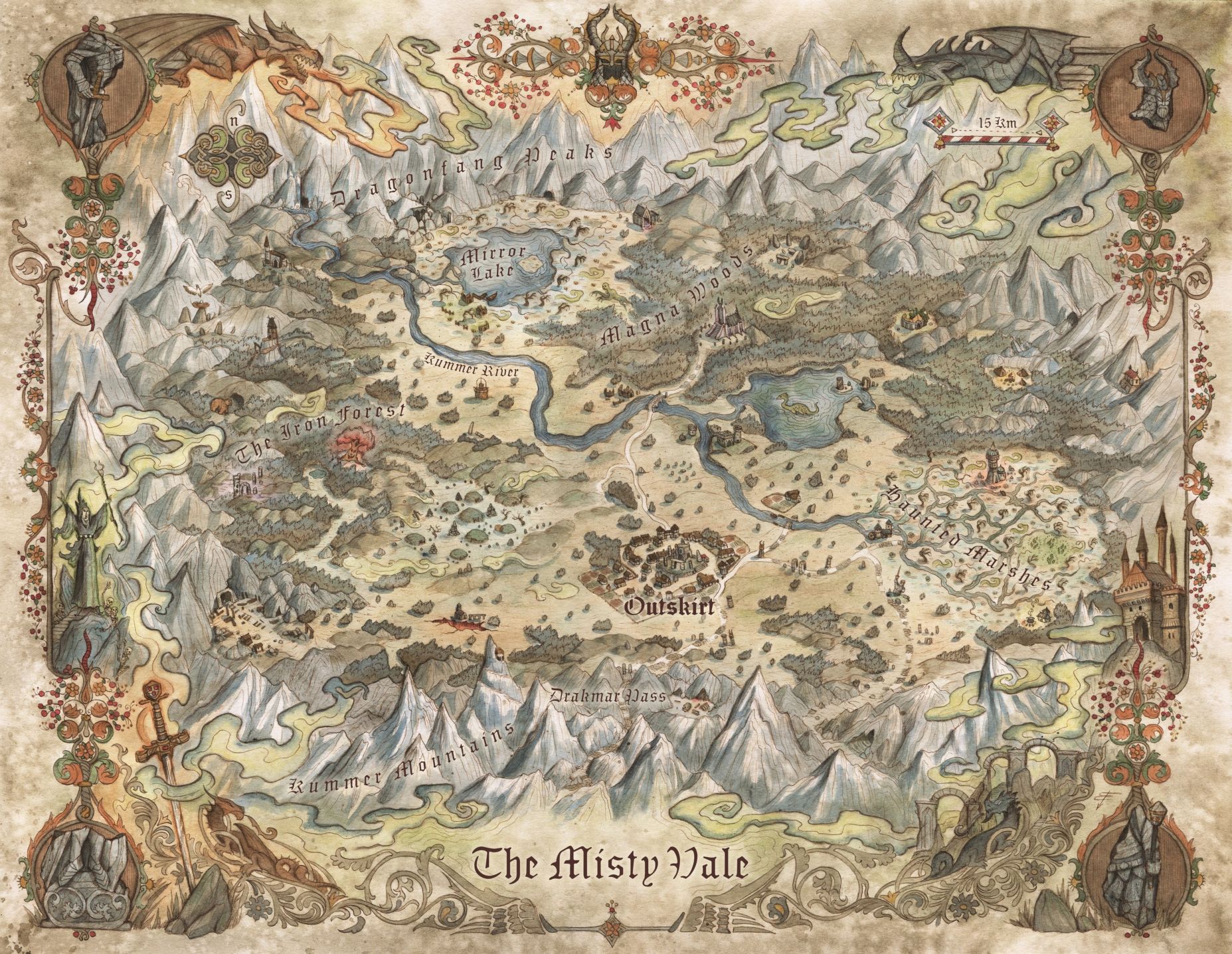
So, the current beta contains the complete Rulebook, the half-finished Adventure book, initiative cards, improvised weapon cards for inns, caves, forests, a map of Misty Vale, and a map for the town of Outskirt. Each one of them is pleasing to the eye with a predominantly brown and green colour scheme, breezy layout, and stunning illustrations. I would have loved to see some Paul Bonner art too, but I guess his mythic tone would not fit the "mirth & mayhem" motto1.

The Rulebook is 116 pages long and covers both how to play and run the game. The short page count is largely the result of terse, effective, no-bullshit writing. The latter still needs some refinement: some abilities would benefit from more clarification, some skills should have more telling names, and sometimes the text feels awkward - probably the result of English being the second language of the writer.

Character creation is swift and straightforward. There are six kin (human, halfling, dwarf, elf, mallard, wolfkin), each with one or two unique abilities and a table of six names. There ten professions (artisan, bard, fighter, hunter, knight, mage, mariner, merchant, scholar, thief), each with a recommended key attribute, skills, heroic abilities2, three equipment packages, and six names3. Age category is a surprising artifact: the older your character is, the shittier the attributes are, but the more skills they start with. Once you have your kin, profession, and age, you can roll up your six attributes (Strength, Constitution, Agility, Intelligence, Willpower, Charisma) using the 4d6k3 method. After each roll you must assign it to an ability score, and can swap two scores in the end4. Now you can calculate your derived ratings (Movement, Strength Damage Bonus, Agility Damage Bonus, Hit Points, and the mouthful Willpower Points), choose your trained skills, and you are good to go. The base chance for skills is based on their relevant attributes, which is doubled for trained skills. Other than these you must also define motivation, gear, memento, appearance. Every step offers you to choose or roll on a table - whatever floats your boat.

Yes, you can play as a wolfkin
with a catfolk fursona.
Encumbrance and experience are also explained here. They follow BRP traditions with some changes. You can carry STR/2 items, but worn armour and weapons at hand don't count. Heavy objects count as multiple items, while others are so small, that you need multiple pieces to count as one item. Skills gain advancement mark for critical and fumble rolls, plus by answering a post-session questionnaire about your achievements. Once you have all your advancement marks set, you roll for each skill. If you exceed their current score, the skill improves by one point - up to 18. You can also train skills with a teacher, though there is nothing about how much they would ask for their services5.

The mechanics use a d20 roll under method for attribute and skill tests alike. There is no resistance matrix like in older BRP games, they are handled by opposed tests. Instead of bonuses and penalties there are boons and banes, which are akin to D&D's advantage and disadvantage: roll twice, take the better roll if you have a boon, or the worse if you have a bane. Fumbles happen on 20 and are called demons, criticals happen on 1 and are called dragons. Failures can be pushed, meaning you can reroll at the cost of gaining a condition. There is one condition for each attribute, and while they are in effect you roll every test affected by it with a bane.

The current skill list offers 20 general skills, 10 weapon skills, and 3 magic skills. That's around twice as much as the quickstart and first beta had, and probably the most controversial change. Fans of Free League systems argued, that having more than 16 skills is too much and adds a considerable amount of crunch to the game. I disagree with them, for several reasons.

First, a few more skills don't add more mechanics to the game, but they do help on defining and differentiating the common tasks one can encounter during an adventure. The previous list was uneven in this regard. Social interactions, physical activities, and education alike had only one skill (Persuasion, Athletics, Lore in this order), which made them a cheap and trivial choice for characters who want to focus on either. For other activities it was hazy, which skill one should use. Then there were tasks like performance and crafting, that got no skills, but were tied to professional heroic abilities, which is all fine and dandy for a class-based system - but Dragonbane ain't one of those.

Second, this is a skill-based game (duh). Your characters are differentiated by what skills their had. Their mix and match is what gives these games the flexibility we love these games for. Too few skills, and your game is no better than a class-based game. Heck, some games reduce their skill lists to a point where they should just drop the idea of separate skills and ability scores, and just merge them6. Why write a skill-based system at all if you don't want a proper skill list?

Third, this is a game with 40 years of legacy. You have to keep some degree of similarity and compatbility with older content and appeal to fans of earlier editions. People who know Drakar och Demoner want to play Drakar och Demoner, not "Forbidden Lands D20 Roll Under Edition". Dragonbane already gets way too much crap for having too many D&D-isms and Forbidden Lands-like mechanisms.

Speaking of D&D-isms, we have feats too, called Heroic Abilities. They include passive bonuses (like improving HP and WP) and active abilities (which cost of WP) alike. You get one Heroic Ability in the beginning, and a new one after reaching 18 in a skill or performing a grand heroic deed.7 It is a diverse list that has both some characterful options and some musthaves - like those that allow multiple attacks or parries, dodges.

Onward to battle! The biggest difference from BRP-based games is the lack of strike ranks or DEX/INT ranks. Initiative is determined by drawing from a deck of cards marked one to ten. You can delay action by swapping cards with those coming later down the line, and there are Heroic Abilities that allow you to manipulate initiative. Your character can move and perform a single action. Parries and dodges use up your action too. Because of this brutal limitatation you must take into account the initiative order to make smart decisions. A wasted action can be the difference between life and death. If you are familiar with BRP, the rest of combat will be nothing new: attack rolls are contested by parry or dodge rolls, on a success you roll damage, subtract Armor Rating. There are rules for critical hits, fumbles, severe injuries, weapon vs armour type, and of course a bunch of spot rules for all kinds of hazards. Fear is surprisingly elaborate with is table of random effects.

That's some cool art. It would be a shame
if the chapter didn't have rules for demonology
and necromancy...
Spellcasting requires WP and a successful skill test. Your character can memorize INT spells, but can also cast from a grimoire at a slower speed. Some spells have multiple power levels, which increases their effectiveness and WP cost. Once out of WP, your character can sacrifice HP for more, but it is an unpredectible process. There are bonuses for criticals, and d20 table of mishaps for fumbles. Similar to RuneQuest, iron hinders spellcasting, so you don't dress your mage in plate armour. Besides generic tricks and spells that everyone can learn there are three schools: Animism (nature and healing), Elementalism (elemental attacks and summoning), and Mentalism (psychic powers and chi). The spell lists are solid but short. Some spells even feel redundant, because they are basically the upgraded versions of other spells. There is a hidden spell tree too: advanced spells require another spell as prerequisite before you can learn them. Overall what you get is a generic spell point-based magic system. There is nothing new under the sun, but it gets shit down. Necromancy ASAP, pls!

Gear is usually the most boring chapter of every rpg. I was pleasantly surprised, that even the blandest item got a meaningful effect neatly summed up in a single sentence. Clothes can protect you from environmental hazards, tools can assist you in tests, wearing an extravagant hat can help with persuading others, etc. Sure, there is a short armour and an exhaustive weapon list too, but here it is the rest of the equipment chapter I fell in love with.

The monster list is barebones with its 15 entries and short chart of 11 common animals. You won't find imaginative weird abominations here, just tired and tested classics. Dragonbane introduces the monster mechanics from Forbidden Lands, which lead to a lot of confusion, partly because the unfortnately chosen name. There are "monsters", who act like environmental hazards with HP, and include supernatural creatures, colossal monstrosities, and swarms. They have a crapton of HP, a chart for attacks, they always hit, but some attacks can be parried, dodged, or resisted. Then there are "not-monsters", which includes NPCs, humanoids, and animals, who work just like your player character. While the monster mechanics are interesting, I would have preferred a more consistent system8. On the other hand, the attack charts have some fun moves, not just Fifty Shades of Damage, and I also dig the Ferocity value, which means how many times a monster can draw initiative9.

The final chapter about running the game is a mixed bag. The rules for handling journeys, foraging, hunting are concise, yet comprehensive - I adore them. The stat blocks of typical NPCs and the random NPC generation table is servicable, though I would move them to the bestiary. There is some generic GM advice and a short guideline for writing adventures supplemented by three random tables, but beyond that you are left to your own devices. Like most modern games, the rulebook doesn't teach you how to properly design an adventure10. I don't expect an entire Tome of Adventure Design in the back of the book, but some more advice accompanied with exact examples would be welcome.

Kudos to Free League for listening to the community and including a printer friendly character sheet in the back.

All this map needs is a hex layer.

The current version of the Adventure Book is 54 pages long and introduces the town of Outskirt, its points of interests, its important personalities, regional random encounter tables, and three adventures: Riddermound (the one from the quickstart), Bothild's Lode, and Temple of the Purple Flame. All three adventures are shorter affairs with simple layouts, but they all have some cool encounters, interesting NPCs, and memorable gimmicks. The presentation is top-notch, with terse writing, clear layout, and effective use of highlighting, colours, and bullet points. I won't take a deeper look into the book for now though, because it's far from complete. Rest assured when the final version drops, I will return to the topic.

Free League has no easy job with balancing between their in-house design principles and the legacy of Drakar och Demoner, especially with both sides having fervent advocates among the fans11. Rewriting the skill list and professions was a big decision that will get a lot of praise and booing alike on the forums. As for me, I am happy with which way then went, and how quickly they applied the changes. Dragonbane promises to be a fun game. The boxed set will be perfect for one shots and short to medium length campaigns, and with proper support I can easily imagine Dragonbane as one's primary game for years long campaigns too.

Until next time!

1 Boy, do I hate this slogan... The game isn't as light, goofy, and heroic as the motto suggests, thanks to its nigh-BRP level of lethality. I guess they had to justify ducks somehow...

2 In the previous version the beginning Heroic Abilities were set in stone for each profession. Opening them up is a welcome change.

3 While I dig the profession-based nicknames, the racial names table feels pretty low effort and useless. Those charts should be at least twice as big. Heck, the Creating NPCs table later has 60 names on it!

4 This method feels awkward. It makes more sense to me to roll first, swap two scores, and then decide about kin, profession, and age.

5 Baffling considering it took a half sentence to do so for the original Magic World back in the day.

6 RuinMasters is a good example: with four attributes and six skills based on them, what's the point of having both? That game also suffers from badly defined attributes and skills, which is partly the result of the excessive minimalization.

7 Originally they were awarded every fifth session. I prefer this approach.

8 Consistency is a key feature of BRP-based games for me. That's why BRP works well as a generic system and why it was big deal compared to D&D back in the day: everything worked the same way. Separate mechanics for monsters feels like a step back, no matter how mechanically intriguing they are.

9 This way monsters can have multiple attacks spread out over the combat round, instead of fucking someone up with one long attack routine once it's their turn.

10 While it's absolutely not my cup of tea, WFRP3e still deserves some praise for having a GM's book that actually tells you how to design adventures and build up a campaign.

11 And then there are the OneD&D refugees too!


Disclaimer: The DriveThruRPG links on this site are affiliate links. If you buy something through the link we'll get some credit for your purchase too.

Monday, 28 November 2022

[Kickstarter] Open for Simplicity

You can't have enough John
Hodgson covers
After my gushing about OpenQuest (even made a character sheet for it while practicing Affinity), I think it's no surprise, that I'm excited about Newt Newport's newest project, which is simply called SimpleQuest. The Kickstarter launched just recently, and if you are quick enough, you can catch the early bird pledge, or be an early bird that catches the pledge worm, or whatever. Once again, there is an option for both dirt cheap print on demand booklet and for a quality sewn printing.

SimpleQuest is a small format, lighter iteration of OpenQuest. The biggest difference mechanically seems to be swapping out the original three magic systems with the unified MP-less One Magic System already introduced in the OpenQuest Companion, otherwise it mostly focuses on trimming down the rules, content, and stat blocks. I won't delve depper into the details about about the differences between the two games, because there is already a preview for a book and a comparison with OpenQuest on the Kickstarter page.

In several ways it seems to be closer to what OpenQuest 3e was intended to look like, before the author decided to stay truer to the roots for the anniversary.  With Dragonbane and SimpleQuest in the pipeline, 2023 already promises to be a good year for fans of BRP and its derivatives.

Friday, 3 July 2020

[Kickstarter] They Came For Your Money

Possible future picture of PoN after
The Palace of Unquiet Repose is released.
The best thing about the pandemic is that all the money I couldn't spend on travel can be blown on ebay and Kickstarter. And July started all gun blazing on the Kickstarter front.

There are 4 days left of the Dunkeldorf: The Prancing Peacock campaign, which I don't want to waste any more word on - I have already talked enough about it.

There are 3 days left of the Giant Slayer!! campaign by Paul Smith (aka Creative Sculpt Studio / Dark Hollow Miniatures), who has been churning out all kinds of cool Oldhammer miniatures in the last few years, from chaos warriors through beastmen to badass mutant mollusks. Despite its name the Giant Slayer!! campaign offers more than a rude giant slayer standing atop a giant's head - which is a scene near and dear to me, because it pretty much happened in my high school Warhammer FRP 2e campaign too more than a decade ago. There are also two lovely valkyrie giant slayers wearing various levels of armour, and a valkyrie sorceress apprentice inspired by Fantasia.

A few days ago Prince of Nothing announced on the Age of Dusk blog the inevitable coming of The Palace of Unquiet Repose. The campaign hasn't even started yet, but the hype is real. Will the dutch luminary's magnum opus shake up the slumbering OSR scene? Will this nordic pundit become the long-waited messiah ushering a new golden age of old-school gaming? And most importantly: will he write a fair and humble review about his own work on his blog?

That's a pretty solid start for the second half of 2020.

Tuesday, 9 June 2020

[Kickstarter] Dunkeldorf: The Prancing Peacock

Last year King Games from Denmark had a kickass Kickstarter campaign to produce a line of medieval townsfolk miniatures heavily influenced by the Warhammer/Oldhammer style. The second campaign called the Prancing Peacock started just today, with a focus on the titular tavern and its patrons. This time the lineup is a mix of hand and digital sculpted minis, though I didn't notice it by my own thanks to the consistent style. I still have a huge pile of unpainted Dunkeldorf metal and resin on my shelves, but that won't hold me back from supporting this one too because I'm a sucker for good old-school metal minis I can use for grimdark low fantasy campaigns.

When the first Kickstarter started I had an interview with Nicki about the project, who was kind enough to send me some samples about what to expect. I just got a notification with a tracking number from PostNord, so expect another preview in the coming weeks. Time to get a rattle can of black primer...

Nomen est omen, there is even a peacock mini!

Saturday, 26 October 2019

Satanic Panic's Great Gnolls

No trace of hyena DNA here.
One little bit of detail that made me raise an eyebrow when first reading the Monsters & Treasures booklet of Original Dungeons & Dragons was the description of gnolls: "A cross between Gnomes and Trolls (. . . perhaps, Lord Dunsany did not really make it all that clear) with +2 morale.".[1] After knowing them as hyena men for years I found this paragraph more than amusing, especially with the included illustration, which shows them as some crouching goblinoid.

Since the release of the AD&D 1st edition Monster Manual the hyena-headed humanoid became the widespread design for gnolls, and I recall very few examples that deviated from them. One of them was Citadel's FTG Fantasy Tribes Gnolls line, where similar to OD&D's Monsters & Treasures the gnolls were big goblinoids. The line was later renamed to FTG Fantasy Tribes Goblins, and finally became C12 Great Goblins.

This April Satanic Panic Miniatures ran a Kickstarter campaign to release its Great Gnoll line - a bunch of multi-part old-school miniatures inspired by the classic gnolls/great goblins. The campaign was successful, and the figurines are available for sale on the SPM website. A few months ago during a sale I bought two sets, which collected dust until two weeks ago. Despite my aversion towards multi-part miniatures, I had a lot of fun already with these little bastards, and I'm nowhere near finished! I spent a copious amount of time figuring out how to combine the various parts, gluing them together, coming up with the color schemes, et cetera. Alas this project is on hold now, for I ran out of bases, which probably won't arrive in the next two weeks (thanks Brexit).

Crossbow gnoll looks so excited to get primed,
 longsword gnoll not so much.
The minis have separate heads, torsoes, shields, and weapons. While the bodies within a set are identical, the heads are all distinct and characterful - my favorite being the one with the chubby cheeks and buck teeth. For some strange reason there are only three shields for four minis, but the weapons more than compensate for that, because there is a crapton of them. Preparing the great gnolls wasn't hard. There were plenty of flashes to cut down, but none of them were problematic, and the seamlines were few and far between. Be careful with the weapons though! They are a bit fragile, I managed to break a sword while trying to force it into a great gnoll's hand. The "great" part in their name is no joke, they are pretty tall for goblinoids - they are a bit shorter  than my Frostgrave characters, and taller than my Heartbreaker Kev Adams orcs.

Not sure what these charming fellows will be at my table. I might introduce them as "true" gnolls into Old School Essentials, or use them as great goblins in Zweihänder. It's also possible I'll use them as hobgoblins until I find better minis for that - although SPM has some intriguing plans for them too. Speaking of which, SPM has another Kickstarter campaign running as I post this to produce a bunch of multi-part great gnoll boar riders. There are only a few days left, and it's almost funded. If you are not interested in mounted units or you want some footmen too, you can add the original infantry packs and their C variants to the pledge.

A finished great gnoll in classic D&D hobgoblin colours.


[1] Interestingly the Lord Dunsany story the author refers to is How Nuth Would Have Practised His Art upon the Gnoles from Book of Wonders, and doesn't have any description of its titular gnoles. In Margaret St. Clair's The Man Who Sold Rope to the Gnoles one of they are likened to an artichoke, and have tentacles instead of arms.

Wednesday, 8 August 2018

The True Danger of Tabletop Gaming

A monster that makes you quack with fear.
Those christian parents who are afraid that their little angels will turn to Satanism because of Dungeons & Dragons are adorably naive. The real danger of tabletop gaming is not spiritual defilement or moral corruption, but monetary bankruptcy. There are villainous authors and publishers out there, waiting for the right moment to snatch your hard earned cash with a surprise attack. They are quick and efficient: most victims end up confused about where their money went, and when did their DriveThruRPG library grow so big. This summer already had some exorbitant swindles, like the release of Cubicle-7's Warhammer Fantasy Roleplay 4e preview and R. Talsorian Publishing's The Witcher Pen & Paper RPG. If you thought this will be all of it for the season, well I have some bad news for you...

Frog God Games storms Indiegogo with their The City that Dripped Blood campaign, which isn't a brick-sized tome you can beat players to death with (if character death wasn't satisfying enough), but an approximately 24 pages long adventure. I like small modules and the premise reminds me of R. E. Howard's Red Nails (one of my all-time favorite sword & sorcery stories), so I ended up supporting the Cult of Tsathoggua with $6.

Jennell Jaquays hasn't released any rpg-related products in the last thirty years, until now. It seems she gathered enough strength to return with not one, but two adventures - and there are more coming! The Dragon's Secret and Quack Keep were all parts of various Star Hat Miniatures kickstarters, and are now available on DriveThruRPG. I'm almost done with The Dragon's Secret, so expect a review coming soon. As for Quack Keep, my Wisdom checks were successful so far, but rest assured I'm going to fail next month.

While I'm struggling with my last ZWEIHÄNDER session reports and getting the next session going (it's summer after all), the game is growing strong and is about to reach new heights with its MAIN GAUCHE supplement. The content is ridiculously tempting, but I have to moderate my expenses and be satisfied with the pdf version, for now. Daniel, if you're reading this: please call the next supplement BOHEMIAN EARSPOON. I know there are people out there who want to see that title on the shelf.

Oh, and before I forget: Echoes of Fomalhaut #2 is out too.

I should have chosen drugs when I was a teen...

Disclaimer: The DriveThruRPG links on this site are affiliate links. If you buy something through the link we'll get some credit for your purchase too.

Tuesday, 2 January 2018

[Review] Sky ov Crimson Flame

Which metal album is this?
Let's start the new year with a review instead of bullshit resolutions! Owl Knight Publishing's Sky ov Crimson Flame popped up on my radar in 2016's September when its Kickstarter campaign launched. The premise was interesting, the adventure seemed mostly complete, and the author only asked for five bucks. After short hesitation thanks to flashbacks from a past disappointment I backed the project. The planned release was October, but as usual the stretch goals resulted in a serious feature creep which pushed it back to last Spring.

Sky ov Crimson Flame is 64 pages long, with color cover, black & white interior. The layout flawlessly mimics the official DCC line, but once you look at the illustrations you realize you are dealing with a wolf in sheep's clothing: instead of the gonzo sword & sorcery of DCC RPG you are staring at some weird fucked up horror fitting of a Lamentations of the Flame Princess product. There might be no dongs and vaginas, but get ready for some flayed men, intestines, and creepy freaks. The art was done by Jordyn Boci, Nicolò Maioli, and Stefan Poag.

The first half of the module covers the titular adventure, a character funnel for 16-20 level 0 characters. The village sweetheart Balena goes missing, people start disappearing, and the Horned Moon rises on the night sky, which is a bad omen. Folk tales point toward the nearby abandoned castle of the long lost necromancer Balrothhariid as the source of every woe. To make players even more motivated, one of their PCs finds a love letter from the girl. Does one need more reason to storm a hellish dungeon?

Probably my favorite creature from the module.
Within the crumbling castle are twenty-something rooms awaiting for the foolhardy visitors. The ruin offers a good mix of combat, exploration, interactive elements, and loot alike. Our heroes will face flying heads, a huge butcher who loves flaying his victims, a mass of baby heads and limbs, and even the animated flesh Balrothhariid flayed off from himself. Monsters aren't the only threat though: there are plenty of opportunities to fall to death, and activating the soul chamber can desintegrate careless people. The castle is also the resting place of the legendary King Roulreed, and his magical sword Silvallum. That's not the only interesting loot though: the library holds some fun random magic items, like a potion that hulks out the user for a few round, or a lamp fueled by a farting imp that might escape. The most memorable for me weren't these though, but the history of the castle, and the all the foreshadowing that slowly reveals what's going on, and sets the mood for the final encounter.

The final confrontation takes place at the top of the highest tower, where the survivors will find the now flayed Balesa in company of some impaled corpses and a pool of blood. The girl was corrupted by the dagger forged from Balrothhariid's soul, and is about to finish a ritual to become the necromancer's next incarnation. The PCs have six rounds to stop her, and the author offers several ways to do that. No matter how they succeed, the ending will be bleak. On the other hand, if they fail, the ending will be still dark, but they will also have a kickass psychedelic planar battle full of random effects against Balrothhariid. It is a tough battle, but it's a million times more exciting than the normal conclusion.

The adventure ends with the new Splinter Soul spell (with effects ranging from Personality loss to total domination), the Nexus Disturbance Table needed for the post-ultimate battle, a bunch of handouts, a character sheet, and of course maps. The dungeon map is isometric, and much simpler than those in the official DCC RPG product. It might be not as jaw-dropping, but at least it isn't too crammed either.

The second half is the Blight ov the Eastern Forest mini-campaign, a small sandbox region with a hex map, and several adventure sites. Unfortunately it has a few glaring issues. First, while the village of Reed is on the map it lacks any kind of detail. Good sandboxes need a central hub where the party can recuperate, gather information, interact with locals, and spend its hard earned money. Omitting information on the hub is a huge mistake, even if it's just a small village. A few pages would have been enough to help the Judge, but now it's extra work he has to do. Second, the village is in the southeast corner of the map. It's better to have the hub at the center, so no matter where the PCs go you have something, and can expand later as they advance further. Now you will either do some more work in advance to cover some of the southern and eastern areas, or put there some walls like mountains, or do the cheapest lamest thing by asking your players not to venture there.

The points of interest include lairs and small dungeons alike. They aren't all independent pockets within the wilderness: some of them are connected to each other or Sky ov Crimson Flame through history, the sword, or the dagger.

Lair of the Yss'sak hides a wounded monster who tries to trick the party into getting him the silver medallion that restores him to full power. He is afraid of the Silvallum, which can destroy his medallion, but will also lose its power when doing so. Overall this is a cool encounter with a memorable villain, although nerfing the sword after destroying the medallion is a dick move.
A deal with the devil.

Hellspring Hollow is an area corrupted by the blood pouring from a Chaos Lord's still beating heart. The adventurers will have to wade through a forest of flesh-eating trees, a river of blood, and a whirlpool until they find the ribcage holding the heart, and its octopid guardians. It's theme makes the mini-dungeon a bit dull (blood, blood, and more blood), and it also lacks any kind of reward.

Domain of the Coo'ng is a monster lair, and as linear as a tower can be. While the creature has an intriguing origin it's unlikely the players will learn of it or it will have any importance, unless the Judge introduces a way to reveal it.

Jhumbii-Beyr Glen is an area corrupted by a sweet alien slime that turns creatures into gelatinous freaks - most of them are bears who can bounce around. If someone didn't get the reference, it's basically the Gummi Bears meets Giger. It's fun mini-dungeon, though there are too many things that can mess up the PCs permanently.

Sanctuary of the Sightless Sisters was founded by the Margaret, King Roulreed's blind sister, who was exiled to stop gossips about their incestuous relationship. The sanctuary was known for its blinded sisters who took care of the sick and wounded, until it was attacked by the Three Warlock Brothers (who defeated King Roulreed too). This is a small dungeon, but it packs a lot of punch for its size, for it has cool encounters, traps, secrets, and even meaningful treasure. What's better, the characters can make a great sacrifice by ritually gouging out their own eyes to redeem the place, which in turn rewards them with great power!

The Wrook's Hut is home to a strange creature that takes tolls from tresspassers, or their souls if they can't pay. Furthermore, he can controls crows which will try to murder intruders. What really makes this lair interesting is that the Wrook is a random encounter in the forest, and if he has taken any treasure or souls from the party they can be recovered here.

Even the fairies are horrible in the Eastern Forest.
The book ends with the random encounter table and the monster stats. Besides the above mentioned fiends this chapter offers corrupted revenant knights who seek the Silvallum's bearer, undead rabbits shooting strands of hair, baby-headed spider freaks shooting their bowels from their asses, and diseased pig fairies flying with gossamer wings, et al. If you didn't think the adventure was messed up enough already, well here you are!

Sky ov Crimson Flame is a product I find hard to judge. The first half is an excellent funnel that reminds me of Sailors on the Starless Sea in many ways. I can wholeheartedly recommend it, even if you don't want to use it as a funnel. The second half is a half-done sandbox. It's a mixed bag of some really good, and mediocre content. The Judge will have to do put some effort into it to make it work, especially if he wants to make those locations that only offer risk, but no reward of note less frustrating for the players. I can also understand if someone won't pick it up because its outrageous parts, which are sometimes clever and creative, but often feel fucked up just for the sake of fuckedupness. Still, there is a strong imagination at work here, accompanied by solid writing, and good product quality.

Tl;dr: A great character funnel accompanied by an incomplete sandbox, written for DCC RPG, but with heavy LotFP vibe. You can buy it on DriveThruRPG, on the Owl Knight Publishing website, in the Goodman Games Store.

Disclaimer: The DriveThruRPG links on this site are affiliate links. If you buy something through the link we'll get some credit for your purchase too.
Saturday, 6 May 2017

Zweihänder Character Sheets

A WFRP which isn't WFRP?
Must be Malal's work!
Last week saw the arrival of the illustrated rulebook for Zweihänder, which I have already talked about when its KickStarter campaign launched. It might be six months late, but it's finally here, sitting on my hardrive in all its grim and perilous glory. I haven't been this excited for an rpg for years! I love Warhammer Fantasy Roleplay. I love the Old World. A game that modernizes the system and captures the mood of the original setting sounded like a dream come true. Can a small team accomplish that? Was it worth waiting for Zweihänder? Will it become my go-to rpg for grimdark adventures?

I will answer the above questions in a review. I did waste four afternoons to create a character sheet for the game though, which probably tells something. I tried to combine my favorite elements from all the WFRP character sheets I like, while also trying to make the sheet as cartridge-friendly as possible. I hope you will find it useful! Form-fillable version is coming soon.

A4 landscape character sheet for Zweihänder
A4 landscape character sheet for Zweihander (no watermark)
A4 landscape form fillable character sheet for Zweihänder

Update #1: Rumor and Warfare skills have been added, and Movement's calculation is now AB+3 as it should be. The former means less space for skill focuses.

Update #2: The bottom line of the Grimoire was longer than should be, it has been shortened. Form fillable version has been uploaded.

Update #3: Links removed from form fillable pdf.

Update #4: Watermarkless version uploaded.

Update #5: The character sheet has been totally revamped after more than one year of active feedback and use. You can find the new version HERE.

Wednesday, 27 July 2016

Kickstarter: ZWEIHÄNDER Grim & Perilous RPG

Two of my all-time favorite rpgs are the first two editions of Warhammer Fantasy Roleplay - the first edition for the setting, the second for the rules. I remember how excited I was when Fantasy Flight Games announced the third edition. Unfortunately my enthusiasm didn't last long... Instead of a percentile based low fantasy game FFG released a boardless boardgame with needless chits, unique dice, shitton of cards, vivid illustrations, and an even more watered down version of the Old World than the one seen in WFRP2e. I wouldn't have any issues with the game if it was called Warhammer Collectible Adventures, or Warhammer Quest on Steroids, but calling it Warhammer Fantasy Roleplay was a heresy punishable by burning. Strangely FFG haven't felt any need to fuck up the WH40K RPG branch which still used the good old percentile system.

While the WH40KRPGs thrived and saw a shitton of releases, WFRP3e was slowly killed, and WFRP1e/2e endured thanks to the community, whose strongest bastion were probably the Strike-to-Stun forums. Here, Daniel Fox (aka Moniker) started to gather his house rules under the Corehammer title, but his game slowly started to evolve, and transformed into something different. Thus Zweihänder was born. Despite all the differences it still had something FFG's fantasy rpg lacked: the heart and core of WFRP. I've found the playtest docs interesting, and admired the effort, but as time passed I considered it a vaporware and forgot about it.

This spring I had to realise I was wrong. After five years and 240 sessions Zweihänder, the true heir to WFRP is virtually finished. The authors started a Kickstarter campaign to fund the printing, which was funded in five hours. If you live in US, CA, or EU, the gloriously gorgeous black & white hardcover book will cost you $50 with shipping and nice little extras. That's a steal! If you were looking for a dark fantasy rpg then go and pledge! It's even system neutral, so you can use it for your Witcher, Game of Thrones, Dark Souls, or edgy homebrew campaign.